
Systematic Elimination: Testing Every Hypothesis
The first hypothesis was straightforward: if the cable tester said the uplink was faulty, replace the uplink. We contacted our cabling contractor and explained the urgency. Despite zero advance warning, they had an engineer on site within two hours.
Their testing equipment showed the existing cable was actually fine, but they’d seen unusual behaviour from cables before and recommended replacement anyway. New cable installed, everything reconnected, network restored.
Except within an hour, the same pattern returned.
The second hypothesis focused on equipment. The switch on the far end was a legacy dumb switch, perhaps fifteen years old and long overdue for replacement. We sourced a managed replacement immediately and installed it.
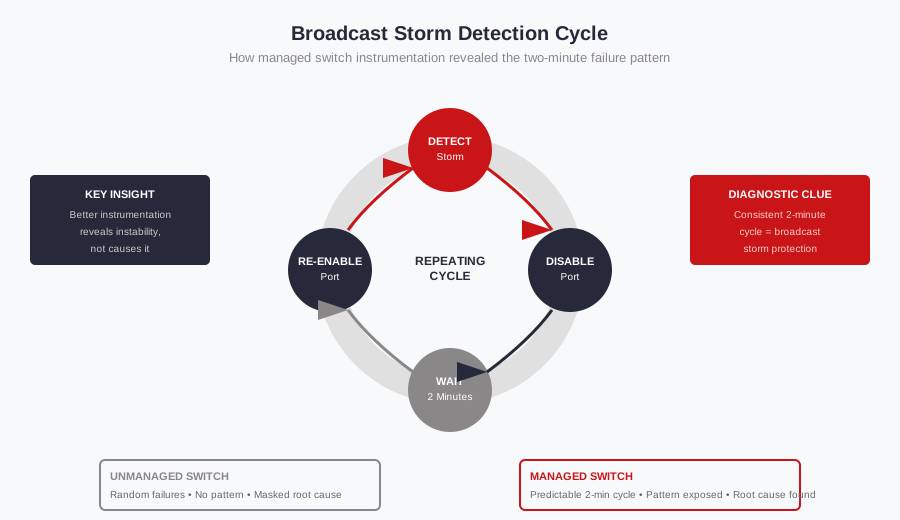
The network behaviour actually became more predictable at this point, which provided the critical diagnostic clue. Failures now followed a consistent two-minute cycle: down for two minutes, up briefly, down again.
This observation changed everything. That pattern is characteristic of broadcast storm protection on managed switches. The switch detects flooding traffic, disables the offending port, waits, re-enables it, and the cycle repeats. The old dumb switch had been masking this pattern with its less sophisticated response to the same underlying problem.
We weren’t chasing a cable fault or an equipment failure. We were hunting a broadcast storm source.
Isolation Testing: Finding the Single Point of Failure
With the problem reframed, the troubleshooting approach shifted entirely. Rather than chasing the storm itself, the goal became identifying the single condition under which stability returned.
Running continuous pings to internal resources, external gateways, and internet destinations provided real-time visibility into network state. The methodology was systematic: disconnect a point, monitor the pings, reconnect, move to the next.
The building had two distinct areas connected by the uplink. Working through every connection point on one side revealed nothing unusual. Everything there could be eliminated.
Moving to the far side where the legacy switch had been replaced, the same process continued. Eventually, disconnecting one specific point caused all pings to stabilise immediately. They stayed stable for two, three, four minutes without interruption.
Tracing the cable back revealed it connected to a VoIP phone in an office area that wasn’t currently in use. The phone had been sitting there since before the refurbishment began, plugged in but essentially forgotten.
Testing confirmed the diagnosis conclusively. Plugging the phone into any network port, even on a different cable, immediately triggered the broadcast storm behaviour. Whether caused by hardware failure, configuration corruption, or some combination, this single device was responsible for the entire day’s disruption.
The phone was isolated and removed from the network. Network stability returned immediately.
Contained Impact, Confirmed Resolution
The operational impact was contained through rapid response. The procurement team worked approximately ninety minutes overtime to capture data they had processed manually during the outages. Operations ran below optimal efficiency throughout the day but never stopped completely. For a business built around speed and responsiveness, even temporary degradation carried real cost.
From a technical perspective, total resolution time from first failure to permanent fix was approximately ten hours, with the root cause identified by 6:30pm. The intermittent nature of the failures and the construction activity on site both extended the diagnostic timeline beyond what a straightforward fault would require.
The legacy phone has been isolated for potential further analysis, though given its age and the planned infrastructure improvements, it will ultimately be decommissioned rather than repaired. Network stability has remained consistent since the resolution.
What Made the Difference
Network troubleshooting rarely follows a straight line from symptom to solution. The uplink cable hypothesis was reasonable given the diagnostic data. The legacy switch hypothesis was reasonable given the equipment age. Both were wrong, but neither was wasted effort.
Each elimination narrowed the scope. Each failed fix provided new information. The transition from an unmanaged switch to a managed switch didn’t solve the problem, but it exposed the pattern that had been obscured before. Sometimes improving instrumentation reveals instability rather than causing it.
Edge devices are frequently overlooked as broadcast storm sources. Phones, printers, and IoT equipment sit at the periphery of network architecture and attention. When they fail, the symptoms often point elsewhere first. Isolation testing with live telemetry beats assumption-driven replacement precisely because it doesn’t require knowing the answer in advance.
Equally important was the commitment to remain on site until resolution was confirmed. After multiple false recoveries throughout the day where the network appeared stable only to fail again, leaving prematurely would have meant another call the following morning. This reflects the proactive support approach that defines effective managed IT partnerships.
The cabling contractor’s two-hour response time also deserves recognition. Getting skilled technicians on site with zero advance notice enabled rapid elimination of the most likely hypothesis, freeing the investigation to explore other possibilities sooner.
Partnership Trust Through Persistence
The managing director’s response captured something important about how businesses evaluate their IT support relationships. When told that a single forgotten VoIP phone had caused an entire day of network chaos, his reaction wasn’t frustration or blame.
He acknowledged that this is how IT troubleshooting works. You examine everything systematically, replace components, test hypotheses, and sometimes the cause turns out to be the last thing you’d expect. He’d seen enough IT issues to understand that complexity doesn’t always have elegant explanations.
More significantly, he expressed genuine appreciation for the commitment demonstrated throughout the day. Knowing that his IT partner wouldn’t leave until the problem was definitively resolved, regardless of how long that took, reinforced the trust that underpins the broader relationship.
That trust has commercial value. It’s why this client continues expanding the scope of services we provide, from managed connectivity to security to the ERP implementation now underway. Each interaction either builds or erodes the confidence that makes those expansions possible.
A broadcast storm caused by a VoIP phone isn’t a story about technical brilliance. It’s a story about persistence, systematic methodology, and the partnership commitment that keeps you on site until 6:30pm because leaving earlier would mean leaving the problem unsolved.
Facing complex network challenges that require methodical diagnosis? Let’s discuss your infrastructure needs.
