
When Your Hosting Provider Gets Hacked: The DNS Security Risk Most Businesses Never See Coming
Supply Chain Risk • DNS Security Infrastructure
Strategic Summary: A business can maintain flawless internal cybersecurity protocols and still suffer catastrophic operational downtime if its upstream domain host is compromised. By hijacking a travel consultancy’s external DNS zone files, attackers converted a legitimate corporate domain into a high-volume spam relay. This incident highlights why enterprises must move past simple perimeter defenses to implement continuous, automated monitoring of their external DNS record footprint.
The Address Book of the Internet: Inheriting Supplier Risk
Standard corporate compliance frameworks focus heavily on endpoint visibility and training people not to click the wrong link. While user risk management is vital, it leaves a glaring blind spot: the structural integrity of your domain registrar.
DNS records act as the authoritative address book of the global internet. They instruct receiving mail servers exactly where messages should be directed, define which IP ranges are authorized to send data via Sender Policy Framework (SPF), and govern DMARC compliance rules. If an attacker alters these pointers, they can easily exploit clean domains for malicious campaigns, leaving the owner to face the technical fallout.
Rebuilding a blacklisted domain’s reputation is an arduous process. Trust scores are calibrated over time based on long-term sender behavior, message volumes, and recipient engagement. Recovering from an exploitation incident requires maintaining strict, controlled sending cycles and deploying continuous system diagnostic tools—uncertainties that introduce real financial costs for transaction-dependent firms.
Closing the Visibility Gap with Automated DNS Auditing
The core lesson of this incident is unambiguous: whenever an enterprise delegates infrastructure components to a third-party vendor, it silently inherits that vendor’s security posture. For small and mid-market enterprises, the path forward isn’t trying to host complex core naming services internally. Instead, it requires implementing clear visibility and early warning indicators over those external systems.
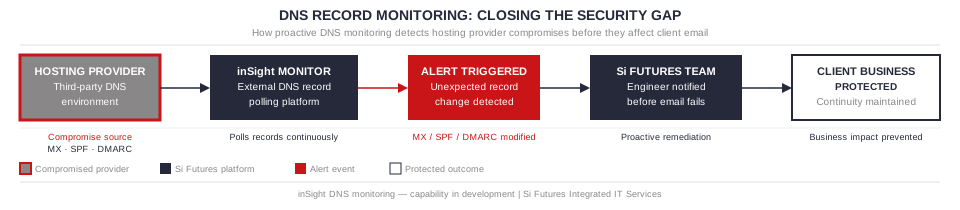
To address this specific exposure, Si Futures has integrated automated DNS polling directly into our central inSight Network Intelligence Platform. Our monitoring infrastructure continuously queries external namespace states, instantly alerting our engineering desk the moment an unmapped shift occurs across an MX record, SPF policy, or DMARC matrix. This continuous auditing closes the gap between an upstream breach and an active operational failure, allowing engineers to intervene before mail delivery collapses.
“Third-party infrastructure means third-party risk. The question is not whether your provider has been compromised — it is whether you would know.”
Consolidating domain management and mailbox oversight under a single technical team ensures comprehensive visibility. Rather than hoping a budget provider maintains robust security, organizations can monitor both ends of their email delivery system simultaneously, replacing assumptions with continuous verification.
Strategic boundary defense requires looking past internal infrastructure to continuously audit the external identity layers managed by your supply chain.
