When Infrastructure Economics Define Your Recommendations
When ADSL first launched in the UK, it arrived years before reaching South Africa. UK branches wanted MPLS connections whilst head offices in South Africa still relied on older last-mile technologies. The technology mismatch wasn’t just a capability gap — it was an economic one that shaped every connectivity decision.
Years later, fibre became cheaper than copper in the UK due to aggressive national rollout programmes. Explaining this pricing inversion to executives in other markets proved incredibly difficult — those market conditions simply didn’t exist elsewhere. When recommending connectivity solutions for UK operations, understanding these infrastructure economics matters as much as technical capability.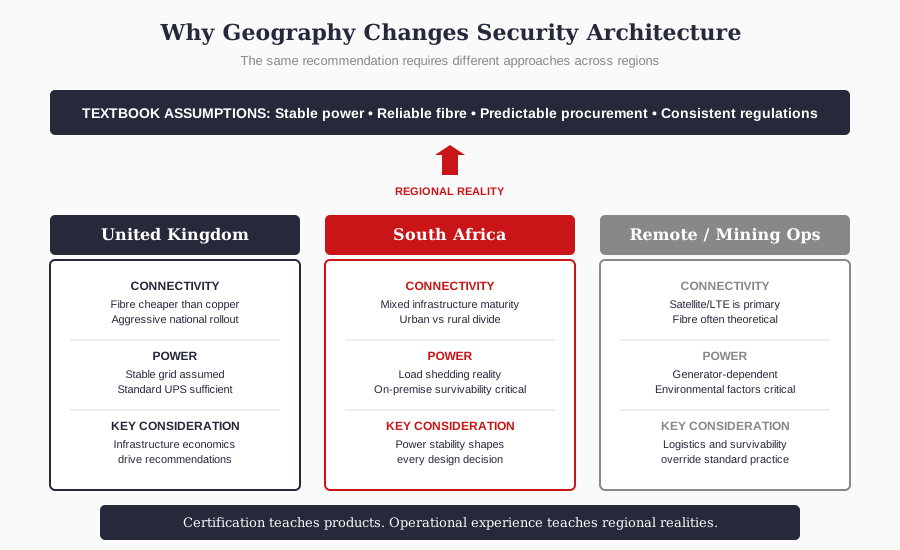
These realities can’t be learned in a lab. You learn them by actually working in these environments, under pressure, when connectivity fails at 2am and your client needs operations restored immediately.
What Multi-Country Security Management Actually Demands
Managing 24 Fortinet devices across eight global sites isn’t a configuration exercise — it’s continuous operational discipline across vastly different infrastructure realities.
Your “business hours” become continuous. A critical alert in Australia needs response when South Africa is asleep. Time-zone aware engineering support isn’t optional — it’s fundamental to maintaining security posture across continents.
Getting a device to site, installing it safely, powering it consistently, and maintaining it — all vary dramatically between regions. Logistics that work seamlessly in London become complex challenges in West Africa. Procurement timelines differ across borders. Onsite support availability shapes your architecture decisions before you ever configure a firewall rule.
Understanding business operations by region matters more than most security architects realise. A connectivity delay that’s minor in the UK could halt production in Zambia. A failover design suitable for Johannesburg may be impractical in remote mining operations. A cloud model perfect for London may be non-compliant for operations in Kenya.
If you haven’t operated in these environments before, you can’t architect for them responsibly. This is where certification stops and capability begins.
Why “Best Practice” Needs Regional Translation
Security architecture textbooks assume stable power, reliable connectivity, predictable procurement, and consistent regulatory environments. Those assumptions rarely survive contact with multinational reality.
Fibre pricing in the UK means nothing when recommending connectivity in Mozambique. Hosting in South Africa may not meet compliance requirements for EU operations. Satellite latency must be factored into distributed SCADA environments. Power stability shapes every design decision in Africa. “Best practice” for London often fails in Lusaka — not because the principles are wrong, but because the operating environment is fundamentally different.
Our teams in the UK and South Africa have spent years delivering secure infrastructure across diverse markets, each with different realities. When ADSL technology gaps existed between regions, we understood why UK branches couldn’t simply “do what head office does.” When fibre economics inverted in the UK market, we explained why recommendations that seemed expensive elsewhere made financial sense there. When load shedding became operational reality in South Africa, we architected security solutions that survived power instability.
That experience — solving actual problems in actual environments under actual constraints — informs every architectural choice we make for multi-country deployments.
Security as Business Enablement Across Borders
Enterprises with multi-country operations can’t afford generic security models. They need teams who understand why specific recommendations work in London but fail in Lagos, why satellite becomes primary connectivity rather than backup in remote operations, and why power infrastructure shapes security architecture as much as threat modelling does.
When you combine deep Fortinet expertise with genuine multinational operational experience, regional infrastructure understanding, time-zone aligned support, and proven delivery across African, European, and Asia-Pacific environments, security stops being a collection of devices and starts enabling business operations across dramatically different conditions.
Managing security across continents requires teams who’ve lived the complexities, solved the challenges, and can design architectures grounded in the realities of each region they operate in — not just certification standards that assume infrastructure uniformity that doesn’t exist in practice.
Certification teaches you how security products work. Operational experience teaches you how security works in places where the textbook assumptions don’t apply.
If your organisation operates across Africa, Europe, or the broader Asia-Pacific region, let’s discuss how we can design and manage security infrastructure that accounts for real-world conditions rather than textbook assumptions.