
The Microsoft Change That Will Break Your Office 365 Backups: Mitigating EWS Retirement Risks
Cloud Architecture • Infrastructure Lifecycle • Business Continuity
Strategic Summary: A fundamental structural change is propagating through Microsoft’s cloud tenant infrastructure, and most organisations will remain unaware of the vulnerability until a critical recovery operation fails. If your enterprise leverages third-party software vendors to back up, archive, or audit your Microsoft 365 data layers, this operational warning requires immediate technical review. Cloud Architect Rudie de Vries analyses the upcoming retirement of Exchange Web Services (EWS) and outlines the engineering steps needed to avoid silent backup failures.
Understanding Microsoft EWS Retirement and its Impact on Enterprise Backups
Microsoft is officially retiring Exchange Web Services (EWS)—the foundational legacy connectivity protocol that numerous external applications have historically used to query and pull data from Microsoft 365 mailboxes. Effective 1 October 2026, Microsoft engineers will systematically begin disabling EWS access across corporate cloud tenants, altering the default administrative configuration that has allowed these background connections to operate. The complete, irreversible decommissioning of the endpoint framework will follow in April 2027.
This does not represent a theoretical or distant future risk vector. Microsoft has already executed the introductory phases of this backend transition. Select enterprise applications are already throwing service access exceptions and returning connection timeouts as a direct consequence of early-stage path restrictions.
Which Data Preservation Tools Face EWS Deprecation Vulnerabilities?
It is important to emphasise that EWS is not the interaction protocol utilised by your primary desktop or mobile email endpoints. Native Microsoft Outlook instances, enterprise web access portals, and authenticated mobile profiles will continue to function without interruption. The architectural vulnerability lies exclusively within every secondary background infrastructure component that interfaces with Exchange Online: automated backup engines, compliance mail archiving pipelines, transactional workflow automations, and custom-engineered line-of-business software that synchronises directly with user mailboxes.
Widespread enterprise platforms, such as MailStore and Synology’s integrated Microsoft 365 backup utilities, have long depended on EWS to manage mass data extraction. If your operations currently run either of these software blocks to protect production Microsoft 365 data states, you must immediately audit your active runtime versions to verify whether they have been re-engineered to run on the modern Microsoft Graph API—the unified development interface to which Microsoft is forcing all cloud integrations to migrate. While the most recent releases of MailStore have successfully incorporated Graph API support, older deployments compiled during or before 2023 remain tightly bound to the legacy EWS protocol. This version mismatch represents a critical operational vulnerability right now.
Crucially, MailStore and Synology are simply prominent examples within a much broader software category. Any background integration or automated script developed over the past decade to interrogate Exchange via EWS endpoints will be uniformly impacted. Many corporate networks house legacy tools of this nature that operate quietly inside back-office virtualisation environments—unattended backup jobs, compliance routing filters, or legal discovery integrations that internal engineering teams have not modified for years because they have historically been stable. On the enforcement date, these systems will silently drop connections.
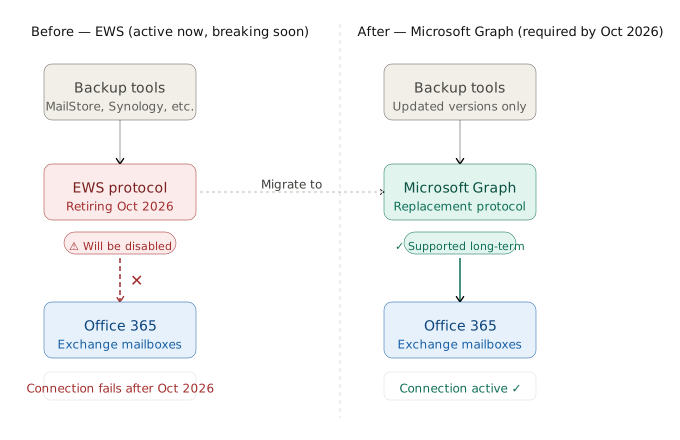
Figure 1: Architectural migration matrix illustrating the deprecation of legacy EWS paths (left) and the mandatory transition to unified Microsoft Graph API data channels (right).
Mandatory Action Steps Prior to the October Cloud Enforcement Deadline
The immediate remediation pathway for IT leadership is straightforward but time-sensitive: manually verify the operational health of your cloud data backup arrays and ensure that all independent data-harvesting software components are completing full synchronisation cycles daily. Silent backup failures represent one of the most severe data governance vulnerabilities uncovered during our structural audits of onboarding client networks—and the deprecation of EWS is about to generate an unprecedented wave of unlogged processing errors globally.
If your enterprise operations rely on a Managed Service Provider (MSP), you must formally direct them to conduct an explicit integration audit. Require written confirmation of whether the software platforms protecting your primary Microsoft 365 assets use legacy EWS calls, verify whether your vendors have issued production-ready updates leveraging native Microsoft Graph access, and demand a granular transition roadmap if the software has not yet been modernised.
If an application vendor has failed to publish a definitive Graph integration lifecycle path, that technical delay constitutes a critical indicator of risk. It implies the necessity of evaluating alternative data protection vendors rather than absorbing the operational window of vulnerability.
The upcoming October deadline is the firm date upon which Microsoft begins active tenant-level enforcement. The remaining remediation window is short, and unlike typical software warnings that permit extended grace periods, this infrastructure deprecation has an absolute enforcement ceiling.
The Strategic Threat of Silent Backup Degradation
Unlogged service failures represent an exceptional threat vector to corporate continuity planners for two reasons:
- Absence of Shock Indicators: A broken backup connection does not trigger a production network outage or impact real-time email delivery. The day-to-day business appears completely nominal while data protection pools remain empty.
- The Remediation Paradox: The systemic failure of a data protection suite is almost universally discovered exclusively during a high-stress recovery operation—the precise moment when the business has zero tolerance for missing historical data archives.
Proactive Lifecycle Management and Infrastructure Auditing
Securing these data assets requires a modern approach to cloud infrastructure strategy that proactively identifies endpoint deprecations long before software layers begin dropping connections. If you are uncertain whether your current Microsoft 365 backup solutions utilise EWS hooks or are fully optimised for Microsoft Graph API pathways, our engineering specialists are positioned to conduct an infrastructure audit of your active cloud configuration to guarantee compliance prior to the Microsoft enforcement date.
Do not allow background architectural shifts to silently expose your business to compliance risks or unexpected data loss. Take the necessary steps to verify your infrastructure stability before legacy connection strings are turned off across your tenant network.
