
What 300 Milliseconds Costs Your Remote Workforce: Eradicating Invisible Friction in Enterprise Terminal Services
Distributed Infrastructure • Performance Engineering • Private Cloud Architecture
Strategic Summary: High network latency is rarely identified as the primary cause of sluggish employee productivity. Instead, it is typically accepted as an unchangeable software limitation. Yet, in terminal services and virtual desktop environments, a 300-millisecond round-trip delay transforms into a continuous operational drag that quietly degrades daily output. Rudie de Vries analyses an international network optimisation project for a financial services institution, demonstrating how migrating thin-client environments into a localised high-performance private cloud eliminates hidden workflow friction.
How Network Latency Subtly Reshapes Operational Behaviour
An international financial services company with operations in Germany had been operating under these exact infrastructure constraints for an extended period. When a workforce adapts to a system delay, they normalise it, losing the ability to recognise it as an infrastructure fault and instead viewing it simply as the baseline performance of the platform. Operational expectations downshift. Employees begin inserting uncalculated pauses between manual actions without realising a behavioral shift has occurred. More importantly, they begin to avoid navigating to deeper audit logs or cross-reference screens simply because the interface loading time feels too slow to justify in the moment.
This dynamic creates a highly damaging impact specific to thin-client architectures. When network response times are low, employees work interactively—navigating fluidly across data points, running quick cross-checks, and verifying data entry. Conversely, when the round-trip time forces a visible wait, user behavior shifts from interactive to batched processing. Data screens are cross-checked less frequently, and the operational pace slows to match the system rather than the system enabling the user. Over time, this systemic slowdown produces operational bottlenecks that mimic broken workflow design. Departments develop inefficient workarounds to avoid using the slow systems. Processes that should require three minutes stretch to fifteen because every step demands a wait. If leadership asks why tasks are delayed, the blame is almost always placed on operational process design rather than network routing.
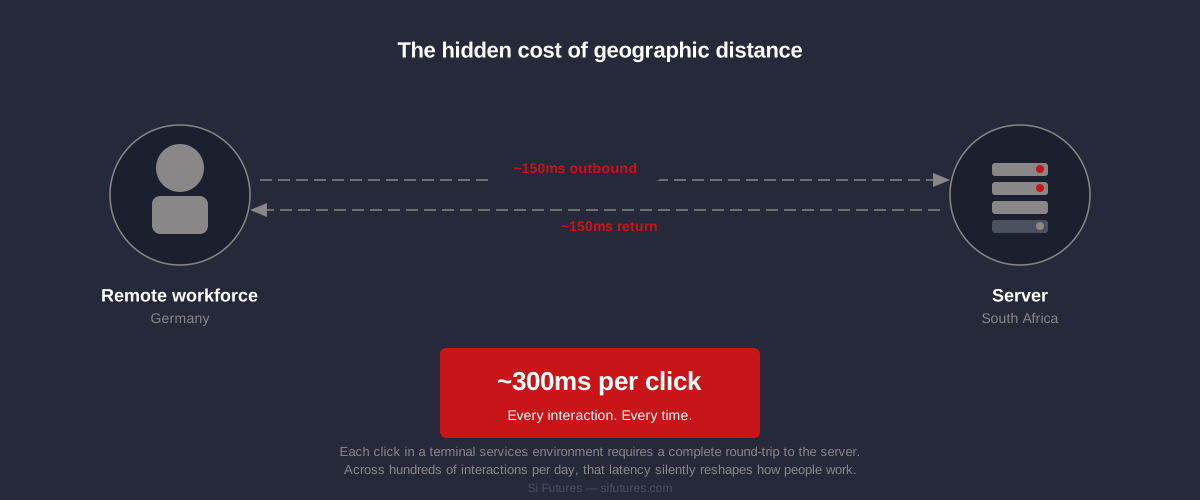
Figure 1: Technical network mapping of international round-trip telemetry and VDI screen-refresh constraints across unoptimised routing backbones.
The Physical Geography Behind Data Packet Delays
The root cause of this operational slowdown was physical geography. The centralised terminal services environment the German financial team was required to access was hosted at a significant distance from their physical office—introducing an inherent 180-millisecond latency overhead on the one-way outbound path, with an equivalent cost on the inbound return. Because every single peripheral movement, keystroke, and screen refresh required a full network round-trip, some transactional requests approached or exceeded a 300-millisecond delay per interaction.
Once the root bottleneck was isolated via comprehensive network path analysis, the engineering solution was clear. The application compute nodes needed to be located closer to the primary transactional backends and databases they integrated with, reducing unnecessary geographical hops.
Relocating Compute Resources to the Si Futures Private Cloud
To eliminate this geographical performance penalty, Si Futures migrated the client’s core terminal services workloads directly into the high-performance Si Futures Private Cloud environment in South Africa. By modernising the network transit paths, the round-trip latency plummeted from nearly 300 milliseconds down to a minimal fraction of that metric. The German workforce immediately experienced what felt like localised workstation performance. In daily practice, system response times became completely indistinguishable from a physical desktop tower connected to a server running down the corridor.
The operational results were instantaneous. Software environments that had felt persistently slow for years now updated immediately. Data processing reports completed without delays, and menu navigation became instant. The workforce regained productive hours they had not consciously realised they were forfeiting, and the systemic friction that had quietly stalled their operational output was entirely removed.
What made this optimisation project notable was not the physical migration of data packets, but the strict alignment established before the migration began. The client possessed an intimate understanding of their application dependencies and business requirements. Simultaneously, Si Futures provided clear documentation on the migration methodology, infrastructure risks, and expected latency outcomes. This collaborative clarity completely eliminated uncertainty before the production cutoff took place. Successful infrastructure overhauls are rarely defined by sheer technical complexity; they are defined by a unified strategic understanding between both organisations before execution begins.
Enterprise VDI and Unmonitored Distance Latency
The expansion of hybrid and remote workforce models has dramatically increased corporate reliance on centralised thin-client systems, but legacy oversights often remain:
- The Legacy Positioning Trap: Compute servers typically remain anchored where the historical IT capital expenditure was concentrated, or where the founding company entities resided, long before international teams were introduced.
- The Unmeasured Cost: Prior infrastructure decisions rarely accounted for the long-term impact of high latency on a remote team’s daily output. Workforces simply forced themselves to adapt to the lag, masking a severe productivity drop.
Proactive IT Strategy Versus Invisible Adaptation
Forward-thinking IT support and strategy planning uncovers these performance deficits before your teams are forced to work around them. For organisations that did not account for these geographical delays originally, correcting the mistake is far less disruptive than internal teams often anticipate.
When an application server is positioned too far from the professionals using it, the business cost does not arrive as a single, catastrophic outage event. It accumulates as thousands of tiny, unlogged pauses, compounding quietly across your entire working year. If your distributed workforce relies on hosted thin-clients or terminal servers and has consistently complained about sluggish software response times, the issue is almost certainly a routing failure rather than a software defect. Relocating your core environments closer to the physical heart of your operations is a streamlined process that delivers an immediate boost to your workforce efficiency.
