
When the App Is the Business: A Two-Hour Migration Window That Took Eighteen Months to Reach
Private Cloud Engineering • High-Availability Migrations
Strategic Summary: For a South African logistics enterprise built around a custom mobile ordering channel, the software application is not an administrative tool—it represents the primary sales pipeline, handling up to 90% of daily transactions. When the system’s core developer passed away unexpectedly, the firm was left with an unmodifiable technical architecture. Si Futures engineered an intensive eighteen-month mitigation strategy, rebuilding legacy integrations to complete a zero-loss private cloud migration within a strict two-hour window.
The Challenge: Legacy Software Gaps and Missing Source Code
The firm’s entire customer ecosystem relied on the platform to audit dynamic pricing matrixes, check inventory records, file purchase orders, and modify logistics quantities. Following the loss of the primary engineer, the company was left with a locked codebase. Necessary bug fixes required ad hoc developers to be brought in blindly during emergencies to address individual bugs, without any understanding of the deeper cross-system dependency mappings.
The most severe vulnerability resided within the database synchronization adapter connecting the mobile ordering application to the company’s on-premises accounting database. This component, which coordinated every single order processed across the region, existed purely as a compiled, closed binary executable. There was no source code archived, meaning modifications were technically impossible. Whenever data sync conflicts occurred, the entire transaction queue locked, requiring a manual process override. Si Futures managed this baseline stability by providing round-the-clock manual restarts and engineering standby coverage for nearly a year and a half.
While a specialized application engineering firm was eventually found to reconstruct the missing software assets, it required eighteen months of careful development to bring the codebase to a stable, maintainable position. The subsequent challenge shifted to execution: migrating the entire platform from shared hosting systems onto an enterprise-grade, dedicated private cloud infrastructure—all without interrupting a distribution business that runs 24/7.
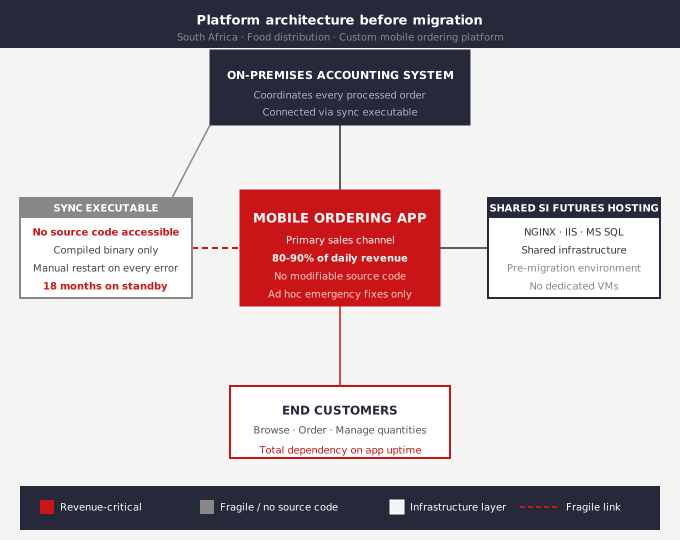
Figure 1: Legacy platform data paths and accounting synchronization connections prior to engineering re-architecture.
Tracing the Data Paths Prior to Cutover Window Activation
To guarantee total business continuity, Cloud Services Manager Rudie de Vries took direct control of the migration mapping, implementing a granular pre-migration checking framework:
- Packet Tracking Analysis: Every distinct application module was treated as an isolated network packet. Engineers mapped every origin point, verified destination addresses, and identified every firewall or gateway block standing between them.
- Operational Timing Design: The migration window was scheduled for precisely 10:00 to 12:00. This slot matches the absolute quietest window in the client’s business lifecycle, safely separating the migration from next-day shipping cutoffs.
- Isolating Platform Dependencies: Deep staging tests exposed hidden allowlist blocks and vendor firewall parameters that would have triggered migration failures if left unaddressed.
Private Cloud Provisioning and Real-Time Remediation
The migration successfully relocated the firm’s architecture into dedicated virtual machines running inside the secure Si Futures private cloud environment. The newly optimized topology utilizes a high-performance NGINX front-end server to manage incoming requests, an IIS application layer to execute core APIs, and an enterprise MS SQL database cluster. Importantly, the unalterable, legacy synchronization executable was completely replaced with a modern HangFire job scheduler engine built from scratch.
During the active two-hour cutover window, three critical technical challenges emerged, requiring immediate engineering triage from our Network Operations Center (NOC):
- API Routing Optimization: Initial logs showed that the NGINX front-end was resolving the application URL externally, routing internal API traffic out to the public internet and back. With thousands of queries generated per user session, this was introducing severe latency. Engineers injected local host entries on the Linux nodes to lock routing paths directly inside the private network fabric.
- Rapid Data Synchronization: The development team had omitted 13,000 product graphics from the staging server, suggesting an external transfer estimate of six hours—a delay that would have broken the migration timeline. The NOC team opened temporary internal network rules, transferring all files across internal backbones in three minutes.
- Identity Access Correction: Security testing exposed mismatched Azure App Registration tokens on the new cluster. Si Futures engineers identified the mismatch and updated the credentials before the discrepancy could disrupt active user sessions.
Commercial Impact and Strategic Future-Proofing
The platform cutover finished exactly on time with zero orders lost, zero database corruption, and no disruption to shipping schedules. The newly deployed HangFire synchronization framework now runs automatically, providing management with clear visibility into live data exchanges through a centralized interface. By moving away from unmanaged hosting systems onto fully monitored cloud solutions, the development team has gained full visibility to roll out updates—such as enhanced database search indexing—that were previously impossible to implement.
“On a platform where the business runs entirely through a single application, the gap between a deployment plan and a tested deployment plan is the gap between a successful migration and a failed one.”
This engagement shows the value of choosing a partner that acts as an active engineering translator and operational safeguard. Simply provisioning unmanaged cloud space is not enough to protect business continuity; executing a successful migration requires an engineering team that deeply understands how every piece of application logic interacts with the underlying data layer.
Strategic system modernization means looking past standard deployment plans to rigorously test, calibrate, and secure your primary transaction engines.
