Automated BGP Failover: Delivering High-Availability Multi-Site Connectivity for Retail Chains
Managed Connectivity • BGP Routing • High Availability
Strategic Summary: A growing retail chain across thirteen locations—including simultaneous expansions at Mams Mall, Kokstad, and Botshebelo Mall—required zero-downtime connectivity for POS and inventory processing[cite: 1]. Si Futures deployed standardized dual point-to-point circuits with automated BGP local preference failover, delivering seamless redundancy without on-site technical overhead[cite: 1].
Challenge: High-Availability Multi-Site Retail Connectivity
Retail operations demand network infrastructure that maintains business continuity during primary provider outages while supporting simultaneous multi-site rollouts[cite: 1]. Every retail branch relies on uninterrupted access for point-of-sale (POS) processing, real-time inventory synchronization, and card transaction terminals[cite: 1].
Multi-site deployment complexity increases exponentially during simultaneous store openings[cite: 1]. Deployments across locations like Mams Mall, Kokstad, and Botshebelo Mall required standardized, repeatable network architecture that ensured enterprise reliability without requiring dedicated local IT staff[cite: 1].
Traditional single-link configurations create severe business vulnerability during carrier maintenance, while overly complex, manual failover setups create management headaches for branch staff[cite: 1].
Approach: Intelligent BGP Architecture
Our multi-site connectivity framework prioritized automated protocol-level failover over manual or vendor-proprietary redundancy schemes[cite: 1]. Each store receives dual point-to-point links terminating into core infrastructure running BGP (Border Gateway Protocol)[cite: 1]:
- BGP Local Preference Configuration: Sets optimal primary path routing during normal trading hours[cite: 1].
- Automated Sub-Second Failover: Triggers instantaneous traffic re-routing to the secondary link upon line degradation or drop, requiring zero staff intervention[cite: 1].
- Seamless Hitless Recovery: Restores traffic to the primary path automatically once health checks pass[cite: 1].
- Standardized Deployment Templates: Ensures identical IP address schema, routing profiles, and security rules across every retail branch[cite: 1].

Figure 1: Automated BGP local preference failover architecture for dual point-to-point retail circuits[cite: 1].
The Core Architectural Principle
Network complexity should be abstracted away from store staff[cite: 1]. Point-of-sale systems and payment terminals must remain continuously online during upstream carrier disruptions without store managers ever needing to restart hardware or switch cables[cite: 1].
Key Performance & Business Outcomes
Measurable performance gains across all thirteen retail branches[cite: 1]:
- Zero Transaction Interruption: Card payments and POS synchronizations remain active during live carrier cutovers[cite: 1].
- Automated Convergence: Protocol-driven failover executes within industry-standard convergence windows without manual intervention[cite: 1].
- Centralized Fleet Visibility: Real-time PRTG telemetry provides centralized uptime metrics across the entire store network[cite: 1].
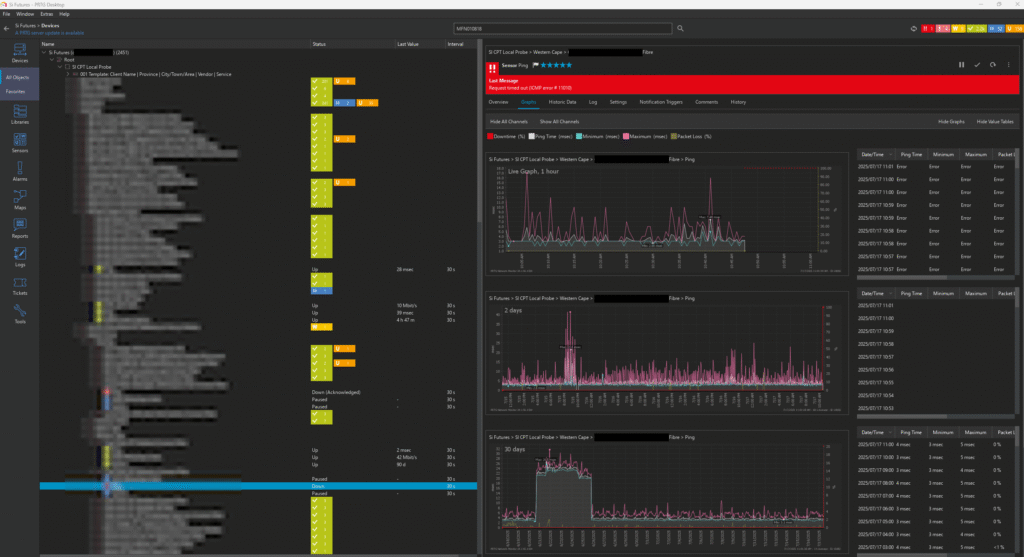
Figure 2: Centralized PRTG network telemetry monitoring primary and secondary path health across retail sites[cite: 1].
Client Perspective & Growth Enablement
“The network just works. Our staff don’t think about connectivity—they focus on customers. When we expand to new locations, we know the technical foundation supports our retail operations without creating management overhead.”[cite: 1]
By standardizing on automated BGP failover, the retail chain eliminated single points of failure while creating a repeatable network blueprint for future store launches[cite: 1]. Explore our managed connectivity solutions or learn more about our comprehensive managed IT services stack[cite: 1].