Investigation Approach: Building an Undeniable Case
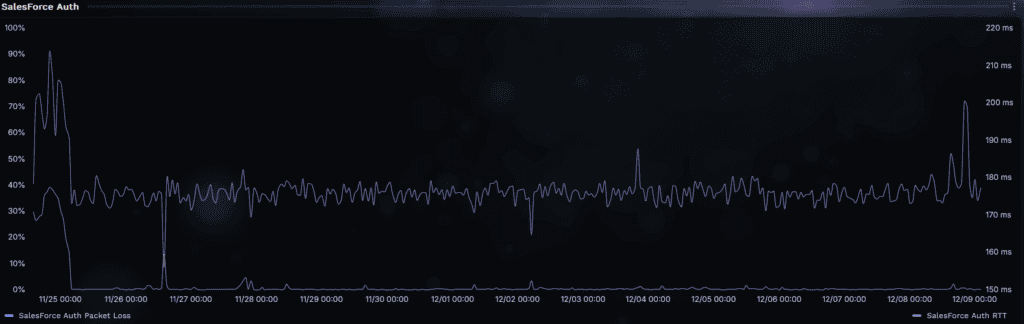
We immediately added Salesforce’s authentication endpoints to our inSight advanced monitoring platform. Within hours, the data told a clear story: we were seeing 20 to 30 percent packet loss across one of our provider’s circuits towards the authentication realm hosted in the UK.
But identifying that packet loss exists is only the starting point. Carriers don’t action vague complaints about performance. We’ve learned through experience that without overwhelming evidence, you end up in endless back-and-forth cycles whilst the actual problem remains unresolved.
We ran aggressive trace routes, polling each hop every second to capture exactly where packets were disappearing. We executed reverse trace routes to understand the return path. We spun up monitoring nodes in territories as close as possible to the suspected problem area. The investigation pointed to a specific peering point in the UK as the source of the loss.
Network Monitoring Solution: Evidence-Based Carrier Escalation
Armed with comprehensive evidence, we engaged with the upstream carriers. The data was unambiguous: timestamps correlating packet loss to authentication failures, trace routes showing exactly which hop was problematic, and monitoring graphs demonstrating the 20 to 30 percent loss rate.
When you present this level of evidence, carriers can’t dismiss the issue or suggest the problem lies elsewhere. They had no choice but to action something. The resolution came at 9pm on a Saturday, when they rerouted traffic via an alternate path within the UK, bypassing the problematic peering point entirely.
The technical implementation involved:
- Advanced monitoring probe deployment targeting Salesforce authentication endpoints
- MTR (My Traceroute) analysis polling each network hop every second
- Reverse trace route execution to map return path behaviour
- Remote node deployment in UK territory for localised testing
- Carrier escalation with timestamped evidence correlation
- Traffic rerouting via alternate UK path
Resolution Outcome: 48-Hour Turnaround with Visual Proof
From initial investigation to confirmed resolution took 48 hours. The packet loss that had been causing authentication failures dropped immediately after the routing change, and the improvement was visible on our monitoring dashboards within minutes.
More importantly, we could show our client exactly what had happened and prove that the fix was working. The line graphs displayed the before and after clearly: sustained packet loss during the problem period, then a dramatic drop-off at the precise moment the routing change took effect.
This visual evidence mattered enormously. Executives who had lost confidence in the system’s reliability could see proof that the problem was identified, understood and resolved. They weren’t being asked to trust that someone made a change and it might be better now. They could see the data themselves.
What Made the Difference: Investigation Before Escalation
Most support interactions with carriers follow a predictable pattern. You report a problem, they ask you to run some tests, you go back and forth, and often the issue either resolves itself or you give up in frustration. The actual root cause frequently remains unknown.
We approach these situations differently. Rather than reporting symptoms and hoping the carrier investigates, we do the investigation ourselves. We build the case. We gather the evidence. We present findings that are impossible to dismiss.
The tooling matters here. Our inSight platform enables end-to-end monitoring from the customer’s actual network position, not from some external point that might take a different path and miss the real issue entirely. When you can replicate the customer’s exact experience and demonstrate precisely where problems occur, carriers take action. This proactive monitoring approach transforms how quickly complex network issues get resolved.
Most MSPs don’t have the capability to detect and escalate international interconnection issues like this. They lack the monitoring infrastructure, the experience with carrier escalation, and the persistence to build an undeniable case. Problems that should take 48 hours to resolve stretch into weeks or simply never get fixed.
Client Impact: Restored Confidence Through Visibility
Our client’s team was, in their words, “chuffed” to see the improvement visualised on our dashboards. Beyond the immediate relief of having their critical business system working reliably again, the experience demonstrated something important about the value of proper managed connectivity investment.
Without advanced monitoring in place, this packet loss would have remained invisible. Users would have continued experiencing sporadic failures, IT would have continued troubleshooting in the wrong places, and the business would have continued losing confidence in systems that were actually functioning correctly, just hampered by an invisible network problem thousands of miles away.
The authentication failures have not returned. Daily operations proceed without the uncertainty that had been plaguing the team. And our client now has monitoring infrastructure that will detect similar issues before they escalate to business-disrupting levels.
Is your organisation experiencing unexplained application performance issues? Let’s discuss how proactive monitoring could provide the visibility you need.