Zero-Hardware Migration: Replatforming 100+ Enterprise Connections Without Site Visits
Managed Connectivity • Network Engineering • Business Continuity
Strategic Summary: When an upstream IPT provider experienced widespread performance degradation affecting over 100 client connections, Si Futures bypassed traditional multi-month hardware rollouts. By reconfiguring existing on-site routers remotely and executing a capacity-conscious, phased cutover, all affected enterprise connections were migrated to a resilient backbone with zero user disruption.
Challenge: The Network Provider Crisis
When your upstream network provider experiences persistent performance issues affecting over 100 client connections, you face a strategic choice: rigid long-term planning or rapid operational adaptation[cite: 1].
Multiple enterprise clients relying on one of our primary IP Transit (IPT) providers were suffering elevated latency and severe packet loss that directly impacted core business operations[cite: 1]. After intensive telemetry analysis, we determined the most effective long-term solution was migrating these clients entirely to an alternative IPT provider’s backbone[cite: 1].
The traditional industry approach would require:
- Deploying new routers to every single client location[cite: 1].
- Procuring and shipping hardware to over 100 distinct sites[cite: 1].
- Scheduling field engineering deployments and multi-hour downtime windows[cite: 1].
With more than 100 affected circuits, that conventional route represented months of logistics, massive capital expenditure, and prolonged client frustration[cite: 1]. We questioned the assumption that physical hardware replacement was necessary[cite: 1].
Systematic Assessment: Utilizing On-Site Hardware
Before ordering a single replacement router, our engineering team evaluated the existing site deployments: what hardware is already in place, and can it handle the re-routed throughput[cite: 1]?
Every affected client was already operating enterprise-grade routers fully capable of handling their bandwidth tiers[cite: 1]. The hardware itself wasn’t failing—the upstream carrier path was[cite: 1].
Having previously proven that customer edge routers can be safely reconfigured remotely to point to new core infrastructure while stripping legacy profiles, we eliminated the need for physical equipment swaps[cite: 1]. Why incur shipping delays, field dispatch costs, and duplicate configuration work when existing, capable hardware can be re-architected over the wire[cite: 1]?
Challenging Deployment Assumptions
By shifting from “ship new hardware” to “re-architect existing edge assets,” we removed four major operational friction points: hardware lead times, shipping logistics, site-visit scheduling, and redundant staging labor[cite: 1].
Intelligent Migration Methodology
We engineered a phased rollout framework prioritizing active business impact over internal operational convenience[cite: 1].
Device configurations were staged and validated in advance[cite: 1]. Upon client approval of the maintenance window, engineers pushed the new network parameters, verified routing and throughput within 2–5 minutes, and safely tore down legacy profiles[cite: 1].
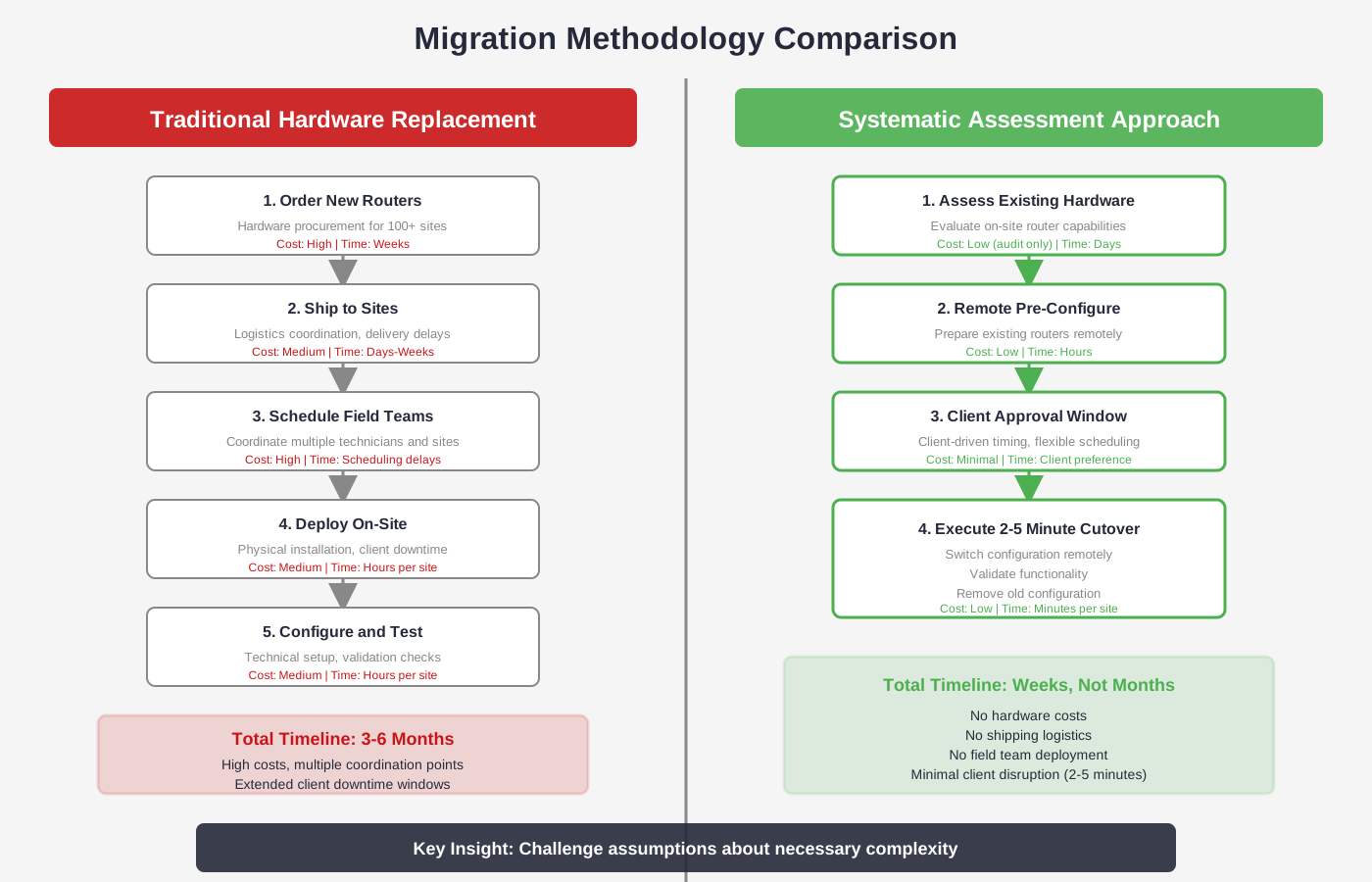
Figure 1: Architectural comparison between traditional hardware replacement vs. Si Futures’ zero-touch remote replatforming methodology[cite: 1].
Phase 1: Active Impact Priority
Clients experiencing active latency or loss were immediately moved to the front of the migration queue[cite: 1]. Operational degradation affecting client revenue always takes precedence over arbitrary numerical schedules[cite: 1].
Phase 2: Capacity-Conscious Backbone Scaling
For stable connections, migration followed a strict bandwidth-conscious progression[cite: 1]. Lower-bandwidth circuits migrated first to establish baseline telemetry, followed by 50–100Mbps links, and finally large aggregate pipes[cite: 1]. Continuous backbone load monitoring ensured existing operational traffic was never degraded by incoming migration volume[cite: 1].
Multi-Party Coordination & Continuity
Migrating complex international topologies required tight orchestration[cite: 1]. For example, during the migration of international logistics accounts, our engineering team coordinated point-to-point decommissioning with the outgoing IPT provider while simultaneously collaborating with overseas operations teams to re-key IPsec tunnels without dropping live cross-border traffic[cite: 1].
Key business continuity protections included:
- IP & Routing Preservation: Retaining existing IP allocations and internal topologies until the exact moment of cutover[cite: 1].
- Client-Driven Windows: Scheduling 2–5 minute cutovers during off-peak or edge hours specified by the client[cite: 1].
- Instant Rollback Safety: Pre-staged configuration rollbacks ready for immediate execution if unexpected routing anomalies emerged[cite: 1].
Measurable Outcomes & Key Lessons
Key operational metrics from the 100+ circuit replatforming campaign[cite: 1]:
- Zero Unplanned Downtime: Complex multi-site enterprise environments migrated with zero user complaints or operational outages[cite: 1].
- Instant Quality Restoration: Latency and packet loss issues were resolved immediately upon carrier cutover[cite: 1].
- Simplified Execution: Challenging the necessity of hardware replacement eliminated months of shipping costs and field team overhead[cite: 1].
Why Systematic Pacing Beats Wholesale Cutover
Infrastructure migrations at enterprise scale demand intelligent pacing[cite: 1]. Managing over 100 connections requires continuous core network monitoring to prevent sudden traffic shifts from saturating infrastructure[cite: 1].
A structured rollout timeline reflects mature operational discipline: responsible management of critical business connectivity accommodates real-world safety over artificial deadlines[cite: 1]. Explore our managed connectivity solutions or learn how our proactive IT operations protect business continuity[cite: 1].