Why We Stopped Leaving Internet Routing to Chance
Managed Connectivity • Cloud Architecture • Network Engineering • IT Strategy
Strategic Summary: Traditional MSPs treat internet routing as a black box, reselling upstream bandwidth without path visibility. Head of Technical Services Nicholas Broderick explains how Si Futures’ direct cross-connect into NAP Africa and global routing table ingestion bring ISP-grade network stewardship directly to corporate clients—optimizing cloud latency and providing instant route remediation.
What the Internet Actually Looks Like Underneath
The internet is not a single unified network. It is composed of tens of thousands of autonomous systems (ASNs) operated by diverse organizations that enter into peering and transit agreements to pass traffic. Every time a user streams content or submits transactional data to an enterprise cloud application, the packets are handed off across multiple transit carriers, each dynamically calculating path efficiency.
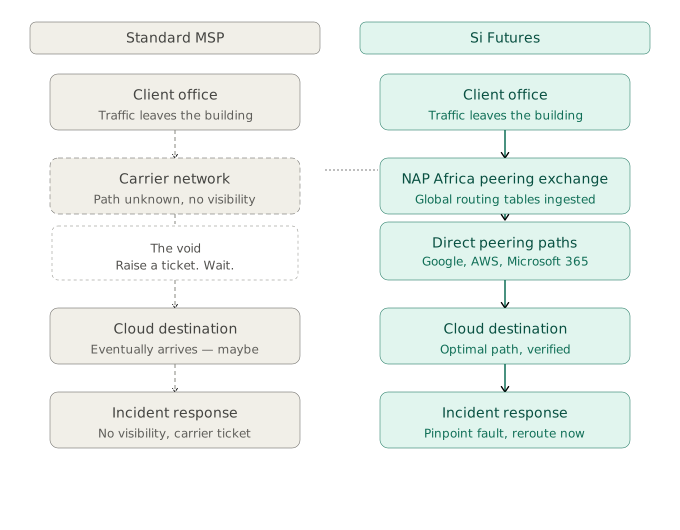
Standard MSPs simply purchase bandwidth from a upstream tier-1 carrier and resell it. They possess zero visibility into the transit path once data leaves their immediate link. They cannot influence routing decisions, nor can they perform granular route diagnostics. When connectivity degrades between a client branch and a public cloud provider, the traditional MSP response is limited to lodging a support ticket with the carrier and waiting indefinitely for a resolution.
We have always viewed that lack of control as fundamentally unacceptable.
The Peering Exchange and Why It Changes Everything
NAP Africa is a carrier-neutral internet exchange point (IXP) housed at Teraco in Johannesburg. It functions as a central meeting point where global hyperscalers—including Google, Netflix, Meta, Apple, Amazon, and hundreds of regional carriers—exchange traffic directly. Rather than routing client packets across multiple intermediary transit networks to reach Microsoft Azure or AWS, a direct peering connection hands traffic directly to the cloud provider’s network edge.
Si Futures has established a direct cross-connect into NAP Africa. Ingesting full global routing tables allows our engineering teams to map major internet paths, dynamically select optimal transit routes, and eliminate total reliance on upstream carriers.
The operational advantage is immediate. Rather than leaving packet delivery to third-party routing logic, our network engineers steer traffic proactively. If a primary path to an overseas cloud cluster exhibits packet degradation or elevated latency, we identify the anomaly in real time and re-route traffic around the point of failure within our own routing table.
What This Means for Managed Connectivity Clients
For daily operations, this architecture yields tangible benefits: reduced latency to major cloud platforms, enhanced path redundancy, and optimal throughput for bandwidth-intensive workflows across Microsoft 365, Google Workspace, and AWS.
The primary advantage emerges during network incidents. Recently, a major enterprise client encountered critical connectivity degradation accessing a specialized financial institution in the United States. Utilizing full routing table telemetry, our team identified the exact transit hop experiencing latency and pinpointed the responsible carrier instantly—bypassing standard carrier helpdesk delays.
This represents true managed connectivity services: proactive network engineering backed by hardware-level path control.
The Hybrid MSP-ISP Model
Historically, a clear boundary separated ISPs (who managed raw link infrastructure) from MSPs (who managed on-premise hardware and desktop support). Clients were forced to coordinate between both vendors when performance degraded, leading to finger-pointing during major outages.
Si Futures operates a unified hybrid model: managing the perimeter FortiGate firewalls, the physical connectivity links, and the BGP routing decisions governing traffic once it leaves the building.
Establishing direct cross-connects at NAP Africa is foundational. From this baseline, we construct dedicated peering relationships with strategic application providers, expanding exchange footprints as client traffic profiles demand.
Integrating network engineering directly into overall IT strategy and planning ensures that corporate connectivity is treated not as a commoditized line item, but as a critical architectural component.
“The MSP with full visibility into your BGP routing table is the same team that can isolate complex latency issues when a public cloud provider cannot. That diagnostic clarity is a fundamental operational differentiator.”
Enterprise Network Stewardship Framework
To ensure maximum uptime and minimal latency for mission-critical cloud applications, evaluate your connectivity provider against these technical benchmarks:
- Direct Peering Controls: Does your connectivity partner peer directly at major Internet Exchange Points (IXPs) like NAP Africa to bypass public transit hops?
- Global Routing Table Visibility: Can your team analyze BGP paths in real time to diagnose transit degradation to overseas endpoints?
- End-to-End Governance: Is a single engineering team responsible for managing your firewall edge, physical last-mile pipes, and core routing logic?