
Closing Every Door Before Someone Else Opens It: Proactive Brand Protection in the Global Domain Landscape
Brand Protection Infrastructure • Advanced Domain Security
Strategic Summary: In high-trust environments like wealth and investment management, corporate identity is a primary target for sophisticated fraud. Rather than waiting for a brand impersonation crisis to emerge, an expanding investment firm partnered with Si Futures to audit and harden its global digital footprint. By shifting from reactive domain registration to an automated, multi-registry global blocking architecture, the enterprise permanently closed off thousands of potential spoofing vectors and cross-script homograph attack surfaces.
Bringing Specialisation to the Table: Aligning Tech and Intellectual Property Law
To establish a definitive defense strategy, Si Futures organized an intensive scoping consultation connecting the client’s internal leadership with LexSynergy—a globally recognized domain registrar specializing in corporate brand protection and deep registry relationships—and the client’s legal counsel. A subsequent alignment session integrated trademark specialists and specialized brand defense attorneys.
This multi-disciplinary approach introduced a depth of international domain law and registry access that standard internal IT departments or generalist managed service providers cannot replicate. The client had initially compiled an extensive list of manual domain registrations covering common typos, variations, and regional geographic suffixes. However, the expert analysis from LexSynergy fundamentally reframed their strategy. The specialist group refined the targeted footprint toward structural registrations backed by enforceable trademark protections, introducing an automated architectural methodology that completely transformed how the client safeguarded their identity.
“A long domain name is not a trademark. Owning a variant does not protect the brand. Legal footing in the domain space requires the trademark — and building the protection architecture around it rather than around a list of registrations that grows obsolete with every new TLD release.”
Neutralizing the Homograph Surface and Top-Level Exploits
The centerpiece of the engineered solution was the deployment of Global Block Plus, an automated defense framework that shifts the perimeter posture from reactive to absolute:
- Automated Global Top-Level Defenses: Utilizing an established, verified corporate trademark, a centralized block is enforced across 710 distinct domain extensions simultaneously. Any malicious third party attempting to purchase a lookalike domain under extensions like
.app,.dev, or.cryptoanywhere globally is instantly blocked at the registry level. - Eliminating DNS Administrative Friction: Instead of managing, renewing, and auditing hundreds of individual regional domains manually every year, the block holds automatically as new generic Top-Level Domains (gTLDs) launch, completely removing configuration overhead.
- Defeating Script-Spoofing Vectors: The Global Block Plus architecture extends its coverage to encompass 108,603 visual variations, specifically targeting sophisticated homograph attack matrices.
The Anatomy of a Homograph Attack
The scale of the 108,603 variants requires explicit technical analysis, as it represents a sophisticated blind spot that standard security audits regularly miss. Homograph attacks exploit internationalized character sets (IDNs) by substituting standard Latin letters with visually indistinguishable characters from entirely different scripts, such as Cyrillic or Greek.
An attacker can register an identical-looking domain where a single character is swapped. Because this is a technically unique, valid domain registration, an entry can be configured with flawless SPF, DKIM, and DMARC parameters. When a spoofed email is generated from this domain, it bypasses every standard spam filter and endpoint authentication matrix globally. To the recipient’s mail handler, browser address bar, and human eye, the identity appears entirely authentic because, from a structural routing standpoint, it is a legitimate domain. Global Block Plus proactively reserves and neutralizes this entire multi-script attack surface.
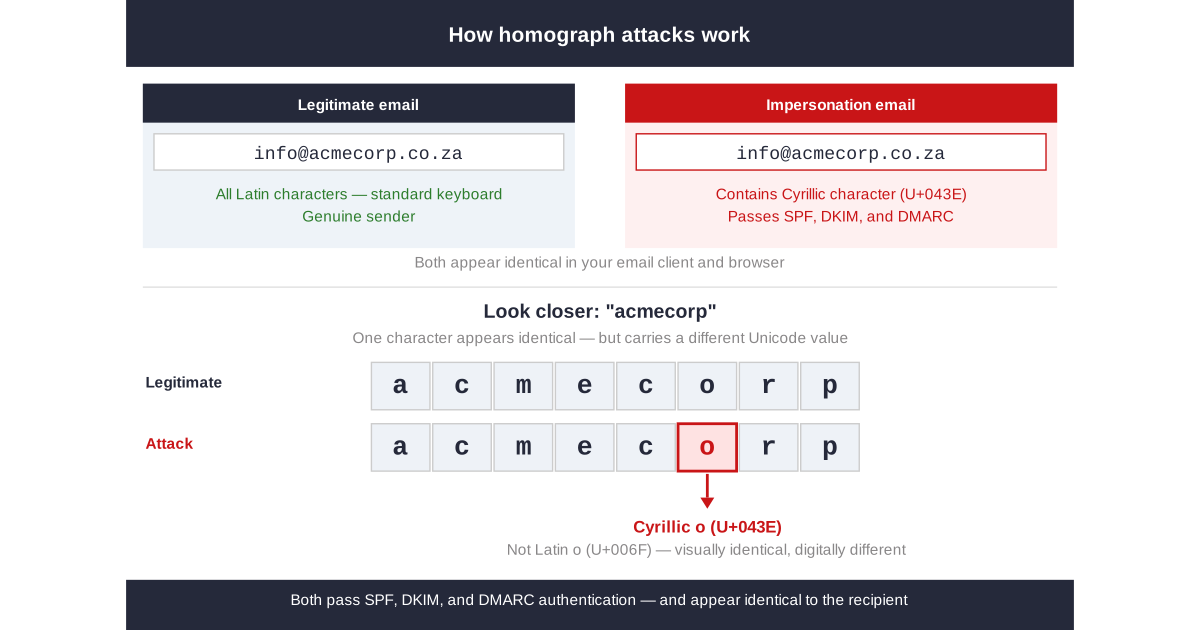
Figure 1: How internationalized script variations allow attackers to pass corporate email authentication filters.
Continuous Discovery and Active Perimeter Response
In addition to blocking new registrations, LexSynergy implemented an active, monthly monitoring and brand watch matrix. This system continuously audits global registry activity for any behavior targeting the client’s intellectual property.
During the initial deployment phase, the discovery audit identified one legacy domain extension that had already been acquired by an unrelated third party. Rather than accepting this perimeter gap as unresolvable, our unified security team immediately placed the asset under an active watch list, logged a strategic back-order position, and initiated a formal intent assessment to prepare for legal recovery protocols.
An Engineered Shift in Security Posture
The enterprise’s defensive perimeter has undergone a fundamental structural shift. The global domain landscape—which previously left them exposed to cross-border brand hijacking—is now securely locked across all major covered namespaces. Future TLD rollouts are automatically insulated by design. The complex character-set attack surface that leaves most traditional corporations exposed has been completely neutralized.
The core infrastructure is now established, and continuous monitoring remains active. Moving forward, any malicious actor attempting to register a lookalike namespace will discover that the platform has already securely claimed the territory, protecting corporate reputation and client transactions by default.
Strategic corporate governance demands moving past reactive domain stockpiling to establish automated registry-level protection across the global digital landscape.
