Cyber Essentials Is No Longer Optional: What UK SMEs Need to Know Before April 27
Regulatory Compliance • Cyber Essentials Update 2026
Strategic Summary: On April 27, 2026, the UK government-backed Cyber Essentials scheme updated its certification requirements, implementing significantly stricter compliance rules. Administered by the National Cyber Security Centre (NCSC) and IASME, the revised standard expands scope tracking to mandate strict cloud-service inclusion, faster software patching, and global MFA enforcement. Enterprises must adapt to these strict parameters or risk immediate exclusion from public sector contracts and larger B2B supply chains.
To ensure total alignment with these shifting standards, we have initiated comprehensive joint certification for both Si Futures UK and Si Futures South Africa. Navigating this framework ourselves gives our advisory teams the hands-on operational insight required to guide our partners through the updated compliance pipeline.
Deconstructing the Cyber Essentials Framework
Administered via the National Cyber Security Centre (NCSC) and delivered in tandem with IASME (Information Assurance for Small and Medium Enterprises), Cyber Essentials verifies that a business independently maintains defensive baseline hygiene across five core control surfaces. The certification is structured into two separate operational tiers:
- Cyber Essentials (Standard): A rigorous, verified self-assessment profile where internal infrastructure setups are documented and reviewed by an independent certified auditing body.
- Cyber Essentials Plus: Integrates the standard self-assessment framework with direct, independent technical testing—including deep credentialed vulnerability scans, live endpoint data audits, and external network probing.
While standard certification provides the right starting point for most UK SMEs, the advanced *Plus* audit is increasingly required by regulators, defense networks, and enterprise supply chain offices demanding formal third-party risk mitigation.
The April 27 Compliance Scope Expansion
While the baseline five pillars remain the structural anchor of the program, the compliance requirements governing them have become markedly stricter. The update formally brings cloud architectures—including Microsoft 365, Google Workspace, and third-party SaaS tools—directly into the mandatory audit scope.
This update means compliance is no longer evaluated on a localized curve; any organization executing or renewing their certification must prove absolute verification across their entire distributed environment.
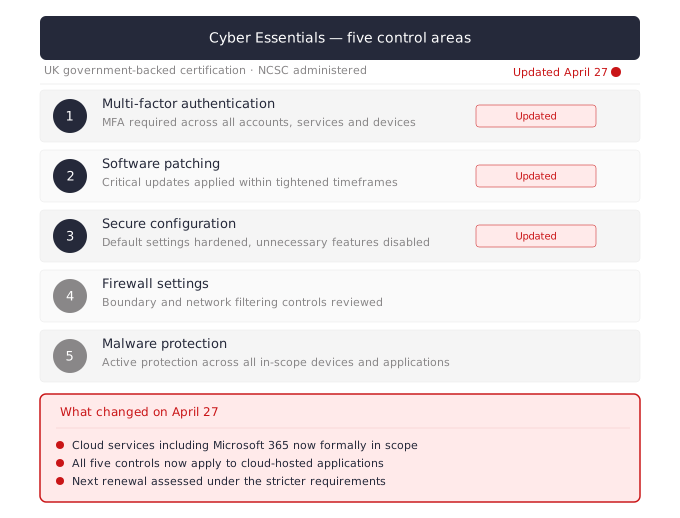
Figure 1: The Five Core Control Pillars under the strict NCSC 2026 mandate.
Common Compliance Roadblocks for SMEs
During the initial evaluation and architecture staging phases, several hidden vulnerabilities regularly surface and delay certification:
- Incomplete MFA Enforcement: Leaving gaps in multi-factor authentication across legacy business tools, external administrative portals, or secondary user groups.
- Legacy Software Lifecycle Risks: Running systems or databases that have crossed their official end-of-life (EOL) marker and no longer receive vital security patches.
- Siloed User Scoping: Overlooking remote branch hardware, field devices, or cloud virtual machines during the initial architectural mapping.
- Privileged Account Mismanagement: Permitting engineers or system managers to execute daily workflows using unrestricted root domain administrator profiles rather than dedicated, monitored admin accounts.
Commercial Impact and Insurance Advantages
While bypassing the certification process isn’t illegal, the commercial penalty of non-compliance can be severe. Uncertified organizations face immediate disqualification during vendor onboarding checks for public sector or enterprise contracts.
Conversely, achieving verified status unlocks hidden operational benefits: UK-headquartered businesses with an annual turnover under £20 million receive up to £25,000 in cyber liability coverage directly inside the Cyber Essentials certification package—providing small-to-medium enterprises with significant financial protection.
“Cyber Essentials is increasingly part of the price of entry in the UK market. It’s a trust signal as much as a compliance requirement — and without it, you risk being excluded from opportunities before the real conversation has a chance to happen.”
With structured IT governance, a standard baseline certification can be secured within weeks. However, organizations requiring network remediation should expect a longer timeline. Initiating an objective threat readiness assessment allows your leadership team to uncover hidden perimeter flaws, fix software tracking gaps, and secure long-term market access.
Strategic compliance means upgrading network perimeters to match evolving NCSC requirements, ensuring your business stays eligible for premium commercial opportunities.