Before You Switch Off the Old System: What a Monitoring Platform Migration Really Takes
Infrastructure Engineering • Observability Architecture
Strategic Summary: After a decade of running PRTG, rising licensing overhead led Si Futures to migrate our enterprise tracking infrastructure to Zabbix. While deep database automation via programmatic AI utilities streamlined the initial configuration transfer, the migration exposed a massive volume of unmapped system data. Balancing this data stream highlights an essential truth in enterprise IT strategy: long-term platform resilience depends on data calibration, not just data collection.
Streamlining Host Transfers with Database Automation
Our primary concern during planning was protecting historical data integrity. With nearly a decade of custom host configurations, dependency mappings, and threshold tuning parameters active in our system, manual migration risked introducing serious tracking gaps.
To eliminate manual export bottlenecks, we bypassed standard web interface tooling. By mapping PRTG and Zabbix identification schemas in parallel and using developer AI agents—including direct database-level automation via Claude Code—we interrogated both backend platforms concurrently. This methodology allowed us to perform a true one-to-one validation audit across every asset, giving us total confidence in our data integrity before altering production workflows. However, moving host configurations proved to be the simplest part of the project lifecycle.
The Calibration Challenge: Managing Hidden System Data
Out of the box, Zabbix implements a significantly deeper metric-collection baseline than legacy tools. Once the initial host migration completed, our engineers were met with an unprecedented surge of system data and operational notifications. The underlying client infrastructure hadn’t changed; rather, the new platform was surfacing deeply nested anomalies that had previously gone unnoticed.
Automated alerts for firewall subscription statuses, cryptographic certificate expirations, and subtle disk hardware failures began triggering automatically. This influx required an immediate, intensive system calibration process. Our engineering teams had to audit every alert rule: Were these triggers capturing valid production risks? Were sampling intervals optimized correctly, or were we simply automating legacy, manual check workflows that needed to be completely redesigned?
Why Precision Trumps Alert Volume in IT Resilience Strategy
In complex enterprise environments, assuming that a higher volume of data equals better protection is a dangerous operational mistake. Uncalibrated alerting systems introduce clear structural vulnerabilities:
- The Window of Failure: Setting sampling intervals too wide risks missing intermittent network drops or micro-outages that impact application availability.
- The Risk of Alert Fatigue: Polling too frequently floods engineering queues with transient alerts, such as minor packet drops that self-resolve within seconds. This noise distracts attention from critical infrastructure emergencies.
- Erosion of Client Trust: False-positive alerts degrade customer confidence, associating proactive monitoring with system noise rather than true operational intelligence.
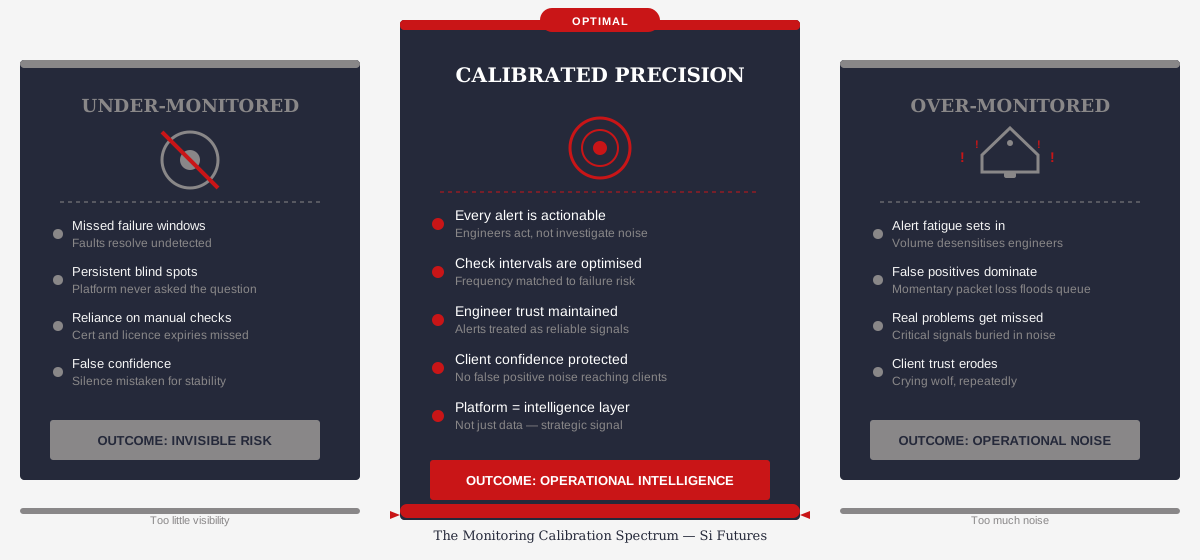
“The purpose of a monitoring platform is not to surface every possible data point — it is to surface precisely the right ones. Calibration is not configuration. It is the difference between intelligence and noise.”
The Reality of Parallel Operations and Hard Deadlines
During the transition phase, we maintained PRTG alongside Zabbix as a secondary fail-safe. While this backup architecture provided peace of mind, running parallel monitoring platforms creates significant operational overhead. If the legacy platform flags an anomaly missed by the new system, engineers must spend time validating if the alert represents a genuine gap or an uncalibrated threshold rule. Dual monitoring means managing dual confirmation workflows and twice the background noise.
To keep the migration moving, we established a firm decommissioning date for the old system. Infrastructure projects without hard deadlines inevitably stall out due to ongoing minor modifications. A definitive cutoff date forces active prioritization, driving the team to finalize agent rollouts, proxy installations, and threshold calibrations. Maintaining a proactive IT support blueprint requires absolute data precision, which can only be achieved through disciplined execution timelines.
Strategic infrastructure visibility requires moving past comfortable legacy configurations to implement highly calibrated monitoring systems that scale efficiently.