Social Engineering Verification: Protecting MSP Standby Operations
Cyber Security • MSP Operations • Incident Response • Identity Management
Strategic Summary: High-pressure, out-of-hours access requests represent one of the primary vectors for social engineering breaches across managed service providers. In this operational retrospective, Cloud Services Manager Rudie de Vries breaks down a 6am standby incident, the rising threat of AI voice cloning, and how enforcing unconditional second-channel verification prevents compromise when bad actors impersonate legitimate users.
The Moment That Changed My Mind on Identity Verification
Something made me pause. Not a single obvious red flag—the caller knew enough internal context about the client’s infrastructure to sound entirely legitimate. It was a broader unease caused by the combination of pressure factors: an unfamiliar voice, an out-of-hours request, an unusual communication channel, and a target destination address outside the corporate domain.
I informed him that I was not comfortable proceeding without direct verification from a known administrative contact at the enterprise, and that I would attempt to establish contact with them first. He was visibly frustrated, repeating how urgently the morning checks needed to be completed.
I reached out to a senior client manager via our verified out-of-band contact directory anyway. Within minutes, I received confirmation: the request was genuine, the engineer was who he claimed to be, and the reset could safely proceed.
In this instance, the caller was legitimate. However, the verification process followed was 100% correct—and the organizational outcome would have been catastrophic had he been an adversary.
Why Social Engineering Identity Verification Matters More Than Ever
Social engineering remains the most effective attack vector against corporate networks because it bypasses technical perimeter controls entirely. It requires no exploit development or zero-day vulnerability—only that an engineer trusts the wrong entity at a critical moment.
What has evolved dramatically is the sophistication of the attacker. Modern Generative AI voice cloning tools can replicate an executive or administrator’s voice using seconds of public audio. Deepfake media and automated intelligence gathering allow threat actors to impersonate known internal contacts with astonishing realism. The voice on the telephone that sounds like your client’s IT Director, referencing real system names and internal project codes, may be completely synthetic.
For Managed Service Providers (MSPs), this operational exposure is exceptionally acute. We manage administrative access to multi-tenant client infrastructure. A single unverified VPN token reset, password override, or privilege escalation executed for an unauthorized requester grants an adversary full access to corporate data pools.
The verification burden falls on us every time. This imperative is precisely why managed cybersecurity must extend beyond automated firewalls to govern the human interaction on the phone line.
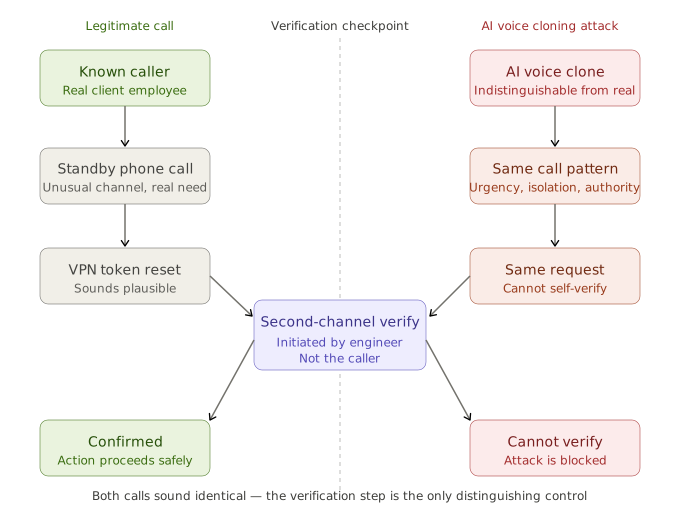
Figure 1: Anatomy of an AI-driven voice cloning attack vector targeting MSP standby desk operations during out-of-hours windows.
Pressure Tactics Applied During Out-of-Hours Security Calls
Social engineering attacks directed at service desks and standby engineering teams consistently deploy a specific psychological framework:
- Artificial Urgency: The request must be handled immediately. Operational downtime or major financial impact is threatened if delays occur.
- Channel Isolation: Standard verification paths are claimed to be unavailable—email servers are down, managers are flying, or hardware is lost.
- Authority Invocation: The caller drops executive names, organizational roles, or internal jargon to project legitimacy.
- Emotional Manipulation: The caller exhibits stress, frustration, or gratitude, leveraging the engineer’s natural helpfulness against them.
Individually, these indicators may not confirm an attack. However, any combination of these factors during an out-of-hours call must slow down execution rather than accelerate it.
The Unconditional Verification Process for MSP Engineers
Verification must be unconditional. It cannot depend on how convincing the caller sounds, how high-ranking they claim to be, or how urgent the operational issue appears.
The rule for modifying any identity, credential, or access right over the phone is absolute: **Confirm the individual’s identity exclusively through a secondary channel initiated by the engineer.**
In practice, if an unverified user requests an access reset, the engineer must initiate contact through a pre-registered phone number, encrypted messaging channel, or secondary administrator on file. If out-of-band confirmation cannot be established, **no administrative action is taken.**
A legitimate user will understand the security requirement. An attacker will lose patience because they cannot intercept or validate a secondary authentication loop they do not control.
This discipline is where our Trusted Response Centre operational governance transforms policy into protection—ensuring that procedure, applied consistently at 6:00 AM on a public holiday, prevents catastrophic corporate breaches.
“An attacker who can clone a voice, replicate a name, and manufacture urgency in real time cannot bypass a second-channel verification step—because they do not control the pre-established channels you already trust.”
Process as the Primary Security Control
Skilled engineers naturally want to resolve problems. Attackers intentionally weaponize that helpful instinct. Removing subjective decision-making during high-pressure calls protects both the engineer and the enterprise.
When strict out-of-band verification is non-negotiable policy, the engineer is never being unhelpful—they are adhering to an immutable security control.
Standby Desk Identity Verification Non-Negotiables
Every MSP and enterprise service desk must enforce these three verification rules for out-of-hours access requests:
- Engineer-Initiated Out-of-Band Callback: Never use contact numbers or email addresses provided verbally during the incoming call.
- Zero External Credential Delivery: Password tokens or recovery links must never be routed to non-corporate domains (e.g., Gmail, Yahoo).
- Mandatory Escalation Thresholds: If out-of-band verification fails, the request remains blocked until senior primary contacts confirm identity.