The UK Data Transfer Compliance Gap in Most Contracts
This month, we spent time building something most of our clients will never see directly: a proper legal framework for how we handle their data, particularly when that data crosses borders. It started with a standard UK master service agreement, the kind of document that sounds unremarkable until you realise how many providers are still working from contracts that were never designed for how businesses actually operate today. Alongside it, we built a reusable data processing schedule, so clients know exactly what happens to their information and why, without having to ask.
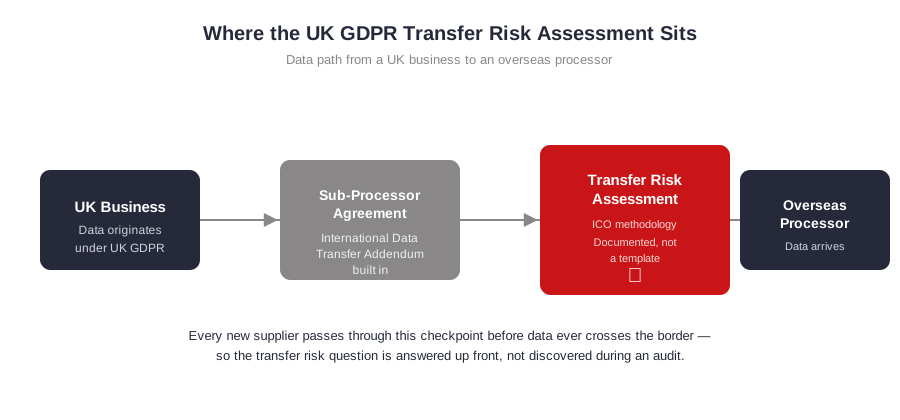
The harder piece was international data transfers. If you’re a UK business and any part of your data, or your supplier’s data, ends up outside the UK, you’re supposed to have a Transfer Risk Assessment in place. Not a token gesture towards compliance, but an actual documented assessment using the Information Commissioner’s Office’s own methodology, addressing the real question underneath the paperwork: is it safe to send this data there, and what happens if it isn’t?
Building UK Data Transfer Compliance Into Every Supplier Agreement
We built a standard sub-processor agreement with the International Data Transfer Addendum built directly into it, so every time we bring a new supplier into a client’s environment, the transfer risk question has already been answered rather than discovered six months later during an audit. And we completed the Transfer Risk Assessment itself, properly documented, following the ICO’s own tool rather than a template borrowed from somewhere convenient.
None of this is glamorous work. Nobody thanks their IT provider for a well-drafted data processing schedule. But when a client asks us where their data goes, who processes it, and what happens if a supplier in another country has a breach, we can now answer all three questions with a document, not a guess dressed up as reassurance.
Why GDPR Compliance for UK SMEs Is a Contractual Discipline, Not Just a Technical One
This is what we mean when we talk about matching technology to business needs. Sometimes that means a new firewall or a smarter monitoring platform. Sometimes it means sitting down and getting the paperwork right before anyone asks for it, so the answer is already sitting there when they do.
There’s a wider point buried in this, too. A lot of the conversation around IT compliance focuses on technical controls: firewalls, endpoint protection, access management. Those matter, and we spend plenty of time on them through our managed cyber security work. But data protection is also a legal and contractual discipline, and it’s one that gets skipped surprisingly often, particularly by growing businesses who inherited a contract from a previous provider and never revisited it. If your current agreement was written for a five-person company and you’re now fifty, the gap between what it promises and what you actually need has probably grown without anyone noticing.
The strongest data protection promise is the one you never have to make out loud, because the paperwork already answered the question.
If your current IT provider can’t tell you exactly what happens to your data once it leaves your building, who is responsible for it along the way, and what the plan is if something goes wrong overseas, that’s worth asking about now. It’s a far better conversation to have on a quiet Tuesday than in the middle of an incident.