When a Personal Device Becomes a Business Risk: Anatomy of a Session Hijack
Identity & Access Governance • Enterprise Risk Management • Microsoft 365 Security
Strategic Summary: Unmanaged personal device access represents one of the most critical security vulnerabilities for growing enterprises, typically remaining hidden until an active exploit occurs. In this post-incident analysis, Group COO Geordie Hogarth reviews an emergency response where an employee’s compromised personal machine led to a targeted business email compromise (BEC) attempt. Learn how session token theft allows attackers to bypass multi-factor authentication, and discover the specific cloud infrastructure controls required to neutralise this entry point.
The Mechanics of an Endpoint Session Hijack
The technical path of this exploit was direct. A personal machine operates completely outside corporate managed infrastructure. It lacks enterprise-grade endpoint detection and response (EDR) agents, central patch compliance tracking, or hardened configuration baselines. When a user authenticates into a corporate mail application on a compromised device—whether infected through a malicious link, unpatched browser software, or a silent background download—active security credentials and browser cookies immediately become exposed to remote threat actors.
In this scenario, the adversary did not breach the entire Microsoft 365 tenant environment. This technical distinction is vital for understanding the blast radius. The broader organization, including shared cloud files and adjacent accounts, remained isolated. Instead, the attacker targeted a single corporate identity by extracting an active session token directly from the compromised personal endpoint.
Once inside the account, the threat actor monitored ongoing email threads to map active operational relationships. Rather than sending messages directly from the employee’s inbox, which might trigger immediate detection, the attacker used an external mail.com address configured to impersonate the business. By referencing real context from intercepted conversations, these spoofed messages appeared highly credible. The actor used this visibility to intercept an upcoming invoice, insert fake payment details, and attempt to route supplier funds to an unauthorized account. Total financial loss was only averted because an alert administrator noticed inconsistencies before approving the outgoing payment transaction.
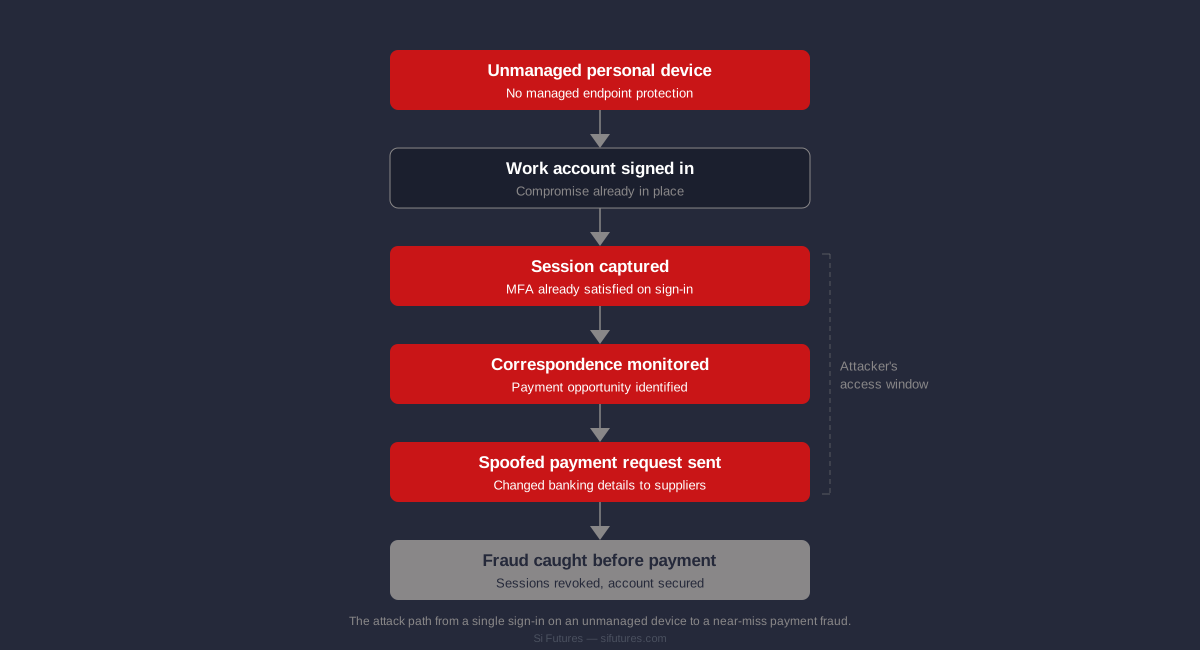
Figure 1: Cross-sectional view of session token extraction on unmanaged endpoints leading to out-of-band domain spoofing and invoice alteration.
The Forensic Response: Isolating and Remediating the Breach
Remediation began immediately upon notification. Our security operations specialists launched a comprehensive forensic audit across the entire Microsoft 365 tenant infrastructure. We confirmed that the scope of the exploit was strictly contained to the individual mailbox level—verifying that no administrator permissions had been altered, and no unauthorized global changes had occurred. The threat was active but successfully isolated.
To evict the attacker, our team revoked all active session tokens associated with the compromised profile, forcing a global log-out. We then executed a complete password reset and re-verified multi-factor authentication enrollment. Following account stabilization, we generated a comprehensive spoofing vulnerability assessment. This technical review evaluated the corporate domain’s email authentication posture—analyzing its Sender Policy Framework (SPF), DomainKeys Identified Mail (DKIM), and Domain-based Message Authentication, Reporting, and Conformance (DMARC) records to identify where additional controls could block external domain spoofing attempts.
The leadership team received a granular, transparent summary outlining the attack vector, the verified state of the cloud tenant, and the exact steps taken to secure their data. By deploying a rapid managed cyber security response framework, the entire environment was fully cleaned and secured before the conclusion of the business day.
The Enterprise Multi-Factor Authentication Blind Spot
While multi-factor authentication (MFA) remains a vital security baseline, it offers no protection against post-authentication session token theft:
Traditional MFA validates identity exclusively during the initial authentication handshake. Once that prompt is satisfied by a legitimate employee on an infected personal machine, malware can extract the resulting authenticated session cookie. By cloning this active session token to a different device, a threat actor can interact with corporate data without ever needing to trigger or satisfy a secondary security prompt.
Enforcing Perimeter Governance with Conditional Access Policies
Mitigating this risk requires closing the gaps between corporate network borders and unmanaged remote devices. Within cloud environments like Microsoft 365, this is achieved by deploying strict Conditional Access policies. These security rules evaluate the health and management state of an endpoint in real time, automatically blocking authentication attempts from any device that fails to meet predefined compliance and management criteria. Pairing these automated technical rules with clear corporate device usage policies removes the human-side guess work regarding acceptable access methods.
While this particular incident ended without financial damage, that success depended heavily on immediate response engineering and manual transaction verification. Had the timeline shifted—such as a malicious request arriving late on a Friday afternoon, or hitting an executive reviewing alerts on a mobile device—the operational impact would have been severe.
If your distributed workforce regularly reviews corporate correspondence from unmanaged home computers without strict endpoint verification, your business data faces ongoing exposure. Contact our enterprise threat detection and response team to analyze your current access layout, audit your authentication rules, and implement the technical controls required to permanently secure your cloud perimeters.