Most managed service providers buy their operations stack.
They evaluate platforms, negotiate licences, and spend months configuring tools built for generic IT environments. The tools may be good. Many of them do the job. But they were not designed around how any specific MSP actually works.
At SI Futures, we took a different path.
What started as a set of practical internal tools has grown into Meridian, our proprietary MSP operations platform. Not an operating system in the traditional technical sense, but an operating framework for how we build, standardise, and improve the way we deliver managed IT services.
It Started With A Problem
Meridian did not begin as a grand strategy, tt began with engineer frustration.
Our team was spending too much time pinpointing where connectivity issues were happening. Was the problem with the upstream provider? A node along the route? A switch? Something on the client side?
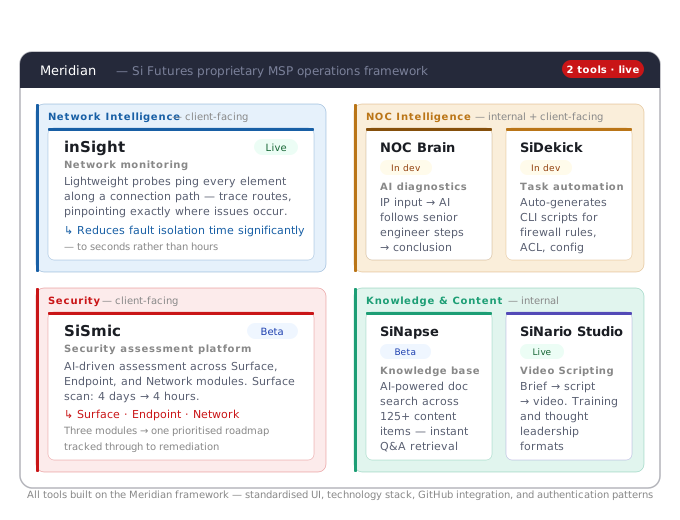
So we built probes: lightweight monitoring agents that constantly ping the elements along a connection path, run trace routes, and show us exactly where to focus. That became inSight.
Then came the next problem. Knowing where the issue is does not always tell you what the issue is.
So Rudie, our Cloud Services Manager, built a tool that allows an engineer to enter an IP address and let AI work through the diagnostic logic. If ICMP is responding but traffic is blocked, for example, the likely issue may be a firewall rule or ACL policy. The tool follows the same reasoning process a senior engineer would apply and presents a practical conclusion. That became NOC Brain.
From Internal Friction to Operational Improvement
The same pattern kept repeating.
One engineer, covering for another who was on leave, became frustrated by the repetitive CLI work involved in adding IP addresses and updating firewall policies. So he built SiDekick, a tool that generates the required CLI scripts automatically. We are expanding it to handle other repetitive, rules-based tasks such as ACL applications, firewall policy updates, and configuration changes that follow a known pattern.
SiSmic came from a different need: security assessment efficiency. A full assessment used to take four days just for the initial surface scan, and closer to ten days of elapsed time for a more detailed audit. By using AI to support the same methodology, we have brought the surface scan down to around four hours. The full assessment process is now being built into an automated tool, grounded in a methodology already validated with clients.
SiNapse addresses one of the most familiar MSP problems: documentation that exists, but is difficult to use in the moment. Documents get written, filed, and then nobody can find the answer quickly enough. For one client site, instead of producing only a traditional document, we built a knowledge base where users can ask questions and get immediate answers. How many users are at the site? What operating systems are the workstations running? The answer comes back in seconds.
SiNario Studio began as a video script generator for our monthly satirical content about the IT industry. It has since expanded into educational video production, turning internal training transcripts into reference videos and creating new ways to bring thought leadership content into a more visual format.
Each of these tools started with a specific operational problem. Together, they show a broader shift in how we think about MSP digital transformation.
Why Meridian Matters
The value of Meridian is not just the individual tools.
It is the framework behind them.
Meridian defines the UI standards, technology stack, GitHub integration, review process, authentication patterns, and development approach that govern how these tools are built. When an SI Futures engineer identifies a problem that could be solved through automation or better tooling, they can start with the Meridian framework rather than building from scratch.
That means new tools are not random side projects. They are standardised, reviewed, and aligned to the way we operate.
For clients, this matters because better internal systems lead to better service delivery. Faster diagnostics. More consistent changes. Shorter assessment cycles. Easier access to knowledge. Less time spent on repetitive manual work. More time spent solving the problem properly.
Building Around The Way We Actually Work
What connects the Meridian tools is not a single technology choice or a product strategy.
It is a practical observation: many off-the-shelf tools are expensive, overly generic, or not quite aligned to the problems MSPs face every day.
With the development frameworks and AI-assisted coding tools now available, there are cases where it makes more sense to build something precise than to spend months adapting something approximate.
That is what Meridian allows us to do.
The tools will be made available to our partners. Whether they are commercialised more broadly is a question we have not answered yet. For now, the purpose is simpler: we are building things that make Si Futures better at what we do.
The most effective MSP technology is rarely the most broadly marketed. It is the technology built by people who understand the problem from the inside — and who had enough frustration with the alternatives to build something better.
If you want to understand what this means for how we deliver managed IT services or how it shapes what we can offer your business, we are happy to walk you through it.