Misconfigured, Not Hacked: Why Your Firewall Settings Are a Bigger Risk Than You Think
Network Security • Infrastructure Compliance Stance
Strategic Summary: Traditional threat models frequently overstate the prevalence of highly sophisticated cyber weapons while underestimating basic administrative errors. For small and medium-sized enterprises (SMEs), the primary vector of network compromise remains firewall misconfiguration. Mitigating this hidden threat vector requires shifting away from superficial review checklists to adopt continuous, automated configuration validation using recognized international security standards.
Why SMEs Face High Firewall Misconfiguration Exposure
This exposure does not persist because smaller companies utilize inferior equipment. A FortiGate next-generation appliance deployed within a 50-person firm features the exact same core operating environment found in global banking networks. The vulnerability lies within continuous technical validation.
Large enterprises maintain dedicated internal Security Operations Centers (SOCs) tasked specifically with auditing, testing, and confirming firewall configurations over time. SMEs and standard IT providers generally lack these oversight layers. As a result, critical security oversights regularly persist undetected for months or years, completely hidden until actively targeted by automated internet sweeps.
The structural gaps surfaced during real-world architecture reviews are rarely obscure edge cases. They typically involve clear configuration oversights:
- Exposed Management Access: Leaving administration portals openly accessible on wide-area network (WAN) interfaces, allowing anyone on the internet to attempt brute-force or exploit connections against the firewall.
- Undefined Trusted Hosts: Failing to restrict administrative login rights exclusively to specific, known internal or management IP addresses.
- Stalled Threat Intelligence Feeds: Allowing FortiGuard subscription updates to lapse, which forces security engines to scan live traffic using outdated definition patterns.
- Legacy Protocol Retention: Permitting weak cryptographic protocols to remain active on VPN tunnels and administrator interfaces.
- Suppressed Operational Logging: Disabling active event logs on specialized access policies, masking unauthorized lateral network movements.
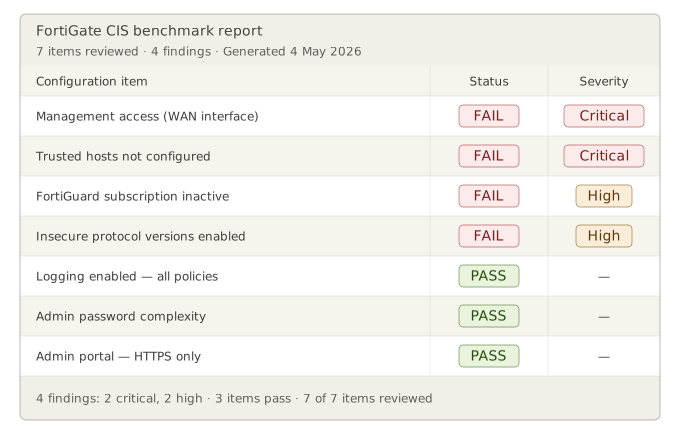
Figure 1: Automated CIS Benchmark compliance reporting tracking explicit configuration integrity profiles.
The CIS Benchmark Standard for FortiGate Fortification
To clear away subjectivity from infrastructure verification, global cybersecurity groups rely on the Center for Internet Security (CIS) Benchmarks. These resources deliver prescriptive, consensus-driven hardening specifications that cover the baseline fields of appliance health:
- Account & Authentication Controls: Eliminating default profiles, mandating multi-factor controls, and enforcing strict password complexities.
- Trusted Path Limitations: Locking down administrative endpoints to explicit management zones while removing insecure protocol iterations.
- Subscription and Update Verification: Tracking real-time updates across threat intelligence channels to counter active software exploits.
- Audit Logging Optimization: Engineering robust logging policies across all active vectors to fuel proactive threat detection and response models.
Automating Compliance via Continuous Engineering
To scale these validation benefits across our managed network security architecture, Si Futures built a programmatic auditing framework. Integrated directly with our secure Unimus deployment, this engine extracts configuration states and automatically evaluates them against the official CIS FortiGate matrix.
This automated approach completely removes manual review delays. It enables regular, hands-free auditing schedules while allowing engineers to instantly trigger on-demand assessments following any policy modification. If a parameter fails the compliance check, the platform isolates the exact policy deviation, details its severity ranking, and supplies clear remediation instructions. When specific environmental dependencies require custom policy configurations, our tool allows engineers to formally document exclusions, providing stakeholders with an accurate, real-world assessment rather than a generic checklist.
We purposefully engineered this framework to eliminate the danger of configuration drift. Policy adjustments made during urgent infrastructure troubleshooting sessions, temporary rules added for testing, or firmware updates that unexpectedly revert default values can instantly introduce security gaps. Moving past casual assumptions to adopt programmatic auditing establishes an objective, repeatable process for verifying edge security integrity.
“The difference between ‘we think the firewall is correctly configured’ and ‘here is the benchmark output that shows it’ is not just a technical distinction — it is the difference between assumption and accountability. For SMEs without a dedicated security team, that accountability has to come from their provider.”
Elevating Business Transparency and Reporting
This continuous tracking data fundamentally reshapes executive reporting metrics. For technology directors, the granulated audit logs show exactly what parameter is being tested and why that setting preserves the perimeter. For business leaders, the executive reporting is clear: your network endpoints are systematically mapped against an international baseline, providing unambiguous visibility into your corporate data protection stance.
True network perimeter security requires moving past unverified assumptions to implement continuous, standardized configuration validation that protects your business from drift.