What Your People Don’t Know: How a Structured Human Firewall Pilot Changes the Conversation
Human Risk Management • Operational Security Governance
Strategic Summary: After a severe phishing near-miss, a client’s leadership team faced a critical question: where do our people actually stand with cyber risk? To answer this definitively without disrupting daily business operations, Si Futures engineered a 10-day, five-document Human Firewall Trial framework. By auditing everyday working habits rather than technical skills, this standardized pilot turns unverified assumptions into clear, data-driven security strategies.
What followed wasn’t a standard corporate request for generic training content. The question posed by their IT director was simpler, yet far more difficult to answer with objective data: where do our people actually stand right now?
It quickly became evident that the only honest way to answer was to run a structured evaluation of our human firewall security platform. We provisioned an identical environment to evaluate eleven initial users, mapping out their risk behaviors. While the resulting metrics were highly valuable, the initial process was too informal and reliant on manual configuration. When a second enterprise arrived with 50 users and the exact same visibility problem, we realized the market needed a disciplined, repeatable deployment framework.
The 10-Day Human Firewall Pilot Architecture
The optimized Human Firewall Trial runs across exactly ten working days, utilizing a 14-day evaluation license. It targets ten representative users carefully selected from cross-functional business units—including finance, administration, supply chain operations, sales, and executive management.
Crucially, the IT engineering desk and highly technical personnel are excluded from this cohort. This specific user selection is deliberate: the core objective of the pilot is to collect an accurate baseline of everyday operational awareness, not to artificially inflate results with advanced technical teams.
To ensure consistent delivery, the entire pilot is controlled by a structured five-document framework, dividing responsibilities cleanly between internal analysts and client stakeholders:
- The Management Summary (Client-Facing): Defines operational expectations, scope limits, and project metrics before any employee interacts with the platform.
- The Trial Timeline (Client-Facing): Maps out the explicit progress steps across the 10-day testing window.
- The Participant Introduction (Client-Facing): Written in clear, non-technical language to engage users and encourage honest baseline behavior.
- The Operational Playbook (Internal): Standardizes backend configuration, simulation delivery, and data handling for absolute consistency.
- The Close-Out Summary (Client-Facing): Distills thousands of data points into high-level business conclusions for executive review.
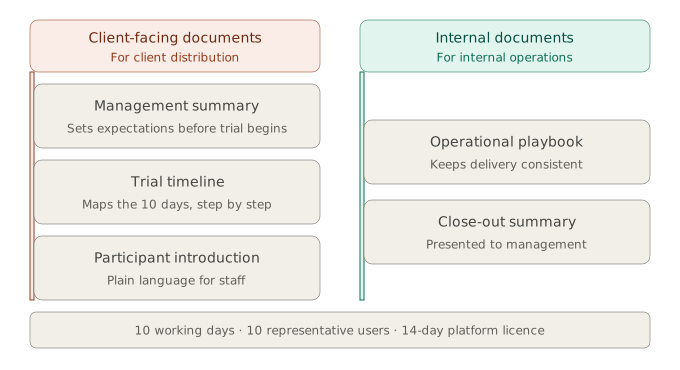
Figure 1: The Si Futures five-document human risk management framework mapping client and internal delivery paths.
Mapping Everyday Habits Across 12 Critical Vectors
The gap analysis does not test academic technical knowledge. Instead, it measures everyday digital habits, processing behaviors, and operational judgment across twelve core areas that modern threat actors actively exploit:
Based on individual results, participants receive exactly one targeted micro-learning unit addressing their single greatest risk area, complete a standard sample security policy acknowledgment, and receive one realistic phishing simulation. By framing the conversation around support rather than punishment, the framework avoids causing employees to disengage out of fear.
Turning Platform Analytics into Executive Decisions
The final Close-Out Summary is where the trial delivers its true strategic value. Rather than overwhelming leadership with rows of raw log statistics, the framework distills the platform analytics into an executive-level roadmap: detailing the team’s true risk baseline, pinpointing unexpected security blind spots, showing actual participation rates, and laying out clear, practical next steps to fix uncovered vulnerabilities.
What frequently surprises managing directors during this review is the sheer unevenness of human risk. Even within small, highly collaborative teams, the performance gap between individual staff members is often significantly wider than management anticipated. While standard areas like phishing recognition or password hygiene regularly return lower baseline scores than assumed, almost every group surfaces distinct areas of operational strength. Highlighting these strengths ensures the post-assessment discussion remains constructive and focused on improvement, rather than defensive or alarmist.
Following the completion of our standardized framework, conversations naturally shift away from abstract worries about cybersecurity toward concrete execution: how do we permanently close these specific human risk gaps? That transition from concern to action is exactly what a well-run professional pilot is engineered to achieve.
“Visibility into where your people actually stand on security awareness is not a nice-to-have. It is the foundation on which every subsequent investment in protection is built.”
Shifting from Software Delivery to Managed Experiences
Handing an enterprise a platform subscription merely grants them access to an unconfigured tool. This framework provides a fully managed infrastructure experience, a clear learning path, objective telemetry reporting, and a high-level corporate roadmap at the end. It elevates the service from simple software delivery to a highly strategic pilot with a clear business purpose.
The resulting summaries provide executive boards with highly practical data, while keeping individual user involvement below 30 minutes total over the ten days. This approach balances deep human risk analysis with day-to-day business productivity. The goal isn’t simply to run phishing tests; it is to give leadership clear risk visibility while keeping the entire process short, targeted, and easy to manage.
True enterprise security architecture requires looking past basic perimeter software to systematically measure, manage, and mature your human defensive layer.