The Resilience Gap: Why Your Network Fails When It Matters Most
Infrastructure Architecture • Business Continuity Governance
Strategic Summary: Modern cloud dependencies mean network downtime instantly cuts off access to mission-critical business systems like ERPs and financial software. While many organizations assume they are fully protected by deploying dual internet connections, they frequently fall victim to the ‘Redundancy Illusion’—where both providers route through the exact same last-mile physical infrastructure. Building true business continuity requires combining physical path separation, automated traffic engineering via SD-WAN, and a unified operational governance layer.
These minor anomalies are the exact technical indicators most organizations overlook until a complete system outage occurs. Across thirty years of designing and maintaining enterprise-grade backbones across the UK and South African markets, the reality is clear: almost every organization believes its managed connectivity is far more resilient than it actually is. This vulnerability persists not because leadership hasn’t invested financial resources, but because the underlying structural assumptions have never been actively tested.
The Hidden Costs of Unplanned Downtime
When leadership evaluates telecommunications investments, discussions are traditionally restricted to raw bandwidth capacity, throughput speeds, and recurring monthly circuit expenses. Financial models rarely budget for the true cost of complete connection loss. Empirical research shows that unplanned infrastructure downtime costs thousands per minute when calculating lost transactions, unallocated staff overhead, disrupted logistics chains, and regulatory exposure under GDPR or POPIA guidelines.
This gap between perceived safety and actual resilience represents a major business risk. The systemic exposure was demonstrated globally in July 2024, when a flawed third-party security software patch crashed 8.5 million endpoint systems concurrently. The resulting disruption forced airlines to ground fleets, hospitals to revert to manual paper documentation, and global financial clearings to stall out. The underlying issue wasn’t a telecom carrier outage or a hardware component failure; it was an unmapped software dependency that introduced an unmitigated single point of failure. The clear takeaway for enterprise teams is that systemic resilience cannot simply be assumed—it must be intentionally designed.
Exposing the Redundancy Illusion
A widespread mistake in business continuity planning is assuming that purchasing lines from two distinct internet service providers automatically guarantees a resilient backup link. In production environments, this strategy often fails.
In both the UK and South Africa, infrastructure audits regularly uncover environments where supposedly redundant circuits route through the exact same last-mile physical infrastructure. If an external excavation team severs a physical fiber conduit, damages a shared underground trench, or disrupts a local street cabinet, both connections fail together. Under this model, an enterprise has paid for two contracts but merely purchased an illusion of safety.
In other architectures, secondary circuits are active but lack automated failover routing logic. When the primary fiber line drops, switching over requires manual intervention from engineers precisely when the internal team is dealing with a high-pressure incident. Furthermore, backup paths are frequently configured once and never tested under real load conditions. When a major service outage occurs, teams discover too late that the secondary link cannot handle the bandwidth demands of their core business applications. Our architectural baseline is simple: redundancy that hasn’t been actively tested under maximum load is not redundancy; it is an assumption, and unverified assumptions fail during critical system incidents.
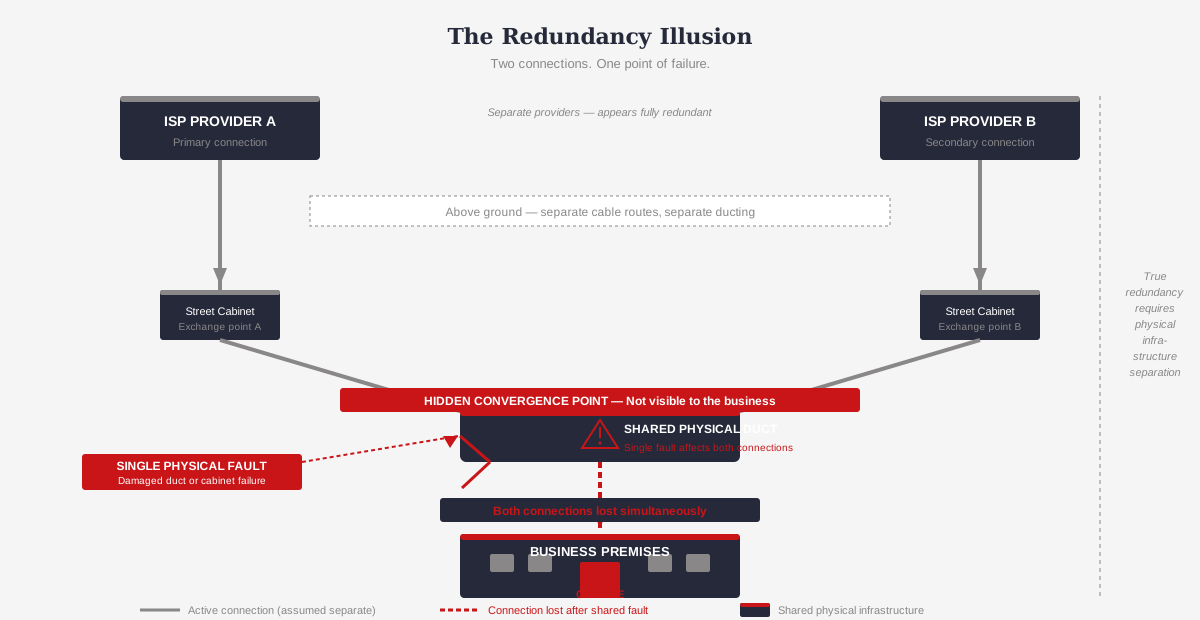
Figure 1: Path convergence within shared last-mile conduits creating fatal single points of failure.
Modern Traffic Optimization: Where SD-WAN Fits
The widespread adoption of cloud software architectures has raised the operational stakes. When critical platforms like ERPs, inventory management systems, and point-of-sale databases run exclusively in cloud environments, an infrastructure drop does more than slow down workflows—it completely blocks system access. Software-Defined Wide Area Networking (SD-WAN) addresses this risk through intelligent traffic engineering:
- Dynamic Application Prioritization: Rather than treating all data packets identically, SD-WAN prioritizes high-priority traffic like ERP syncs and VoIP communications over less critical updates during link degradation.
- The Core Diversification Requirement: SD-WAN acts as an intelligent data router, not a standalone fix for broken infrastructure. If deployed on top of poorly diversified circuits without path separation or proactive testing, it cannot prevent complete link loss.
- The Layered Security Blueprint: Highly resilient systems combine SD-WAN routing logic with genuine carrier diversity, distinct physical routing paths, and continuous automated performance monitoring to address multiple failure points simultaneously.
The Governance Gap and Consolidated Accountability
During a major network outage, the main driver of prolonged system downtime is rarely the underlying technical fault itself. Instead, it is fragmented operational accountability. When an environment relies on an uncoordinated mix of separate ISPs, hardware vendors, and cloud providers, internal teams waste hours coordinating escalations across multiple help desks while attempting to manage an active business crisis.
To solve this visibility bottleneck, our engineering teams operate on a clear rule: a resilient network design must be managed by a single experienced partner who owns the entire connectivity ecosystem. This single group must maintain end-to-end responsibility for carrier relationships, routing policies, performance optimization, proactive failover drills, and rapid incident resolution. Our specialized Trusted Response Centre was built to address this need, ensuring that technically sound redundancy strategies are never undermined by slow vendor responses or unclear boundaries during a crisis.
“The organisations that recover fastest from disruption are rarely those with the most sophisticated infrastructure. They’re the ones that know exactly who is responsible — and have already agreed how that responsibility works under pressure.”
5 Governance Questions for Your Next Board Meeting
If any of these key verification questions generate uncertainty among your leadership team, treat that uncertainty as an early indicator of operational risk:
- Infrastructure Diversity: Are your primary and secondary connections physically separated at the physical layer, or do they converge inside last-mile infrastructure where a single trench cut would disable both paths?
- Automated Failover Verification: Is your backup switchover fully automatic, and when was its failover logic last validated under simulated live load conditions?
- Traffic Optimization Stance: Are mission-critical cloud applications prioritized during network strain, or must business-critical systems compete for remaining capacity against non-essential web traffic?
- Proactive Telemetry Signals: Do your monitoring engines flag connection drops and hardware degradation automatically before your internal teams or external customers encounter issues?
- Unified Management: Is there a single accountable team managing the performance of your entire connectivity ecosystem, or is responsibility distributed across multiple third-party vendors with no primary point of escalation?
Strategic business continuity means moving past comfortable operational assumptions to build highly resilient, continuously validated communication systems.