Telling Clients Before They Tell You: Proactive Certificate and Licence Lifecycle Management
Infrastructure Governance • Automated Visibility
Strategic Summary: The divide between a routine license renewal and an unexpected Friday afternoon outage is defined entirely by proactive lifecycle management. By moving away from manual spreadsheets and connecting our Zabbix monitoring engine directly to FortiGate REST APIs, Si Futures automated certificate and licensing tracking—ensuring critical edge security systems remain uninterrupted through a tiered notification framework.
Managing asset lifetimes manually through review schedules works fine for small setups, but it fails to scale securely across hundreds of enterprise network devices. To eliminate this vulnerability, we leveraged our central Zabbix monitoring platform to query managed firewalls directly for live license compliance and credential health data via secure REST APIs.
Automated Tracking via Tiered Telemetry Thresholds
Connecting monitoring tools directly to physical hardware endpoints allowed us to build an automated tracking layer covering SSL VPN components, deep packet inspection (DPI) certificates, and software parameters. To balance engineering focus with adequate warning buffers, we implemented a structured notification matrix directly inside our Trusted Response Centre (TRC™) workflow:
- 30 Days to Expiry: A standard informational alert populates the engineering dashboard to log upcoming procurement requirements.
- 14 Days to Expiry: The system escalates the ticket to a proactive warning state, initiating engagement workflows with the client.
- 7 Days to Expiry: The issue shifts to a critical alert tier, remaining active until the updated credentials or licenses are securely deployed.
This opinionated framework runs by default for every managed environment. Providing full visibility across every certificate and renewal timeline gives corporate steering committees a regular, transparent demonstration that their technology stack is being actively governed rather than simply reacted to during a crisis.
Policy Hygiene: Closing Forgotten Perimeter Vulnerabilities
Expanding our API integration also unlocked a powerful advantage for corporate compliance: systematic firewall policy hygiene auditing.
- Zero-Hit Analysis: The automated monitoring platform scans all active rule bases to flag policies that have registered zero tracking hits over a 90-day window.
- Legacy Rule Minimization: Identifying unused or orphaned rules allows engineers to systematically strip away obsolete access privileges left over from decommissioned software or past vendors.
- Attack Surface Reduction: Eliminating unneeded rules cleans up technical configurations and directly minimizes the edge pathways open to external cyber threats.
Establishing a Structured Operational Hierarchy
Managing enterprise infrastructure requires filtering out alert fatigue so engineers can focus on critical issues. If a monitoring platform treats a minor license warning with the same urgency as a total backbone circuit failure, real operational emergencies risk being buried in noise.
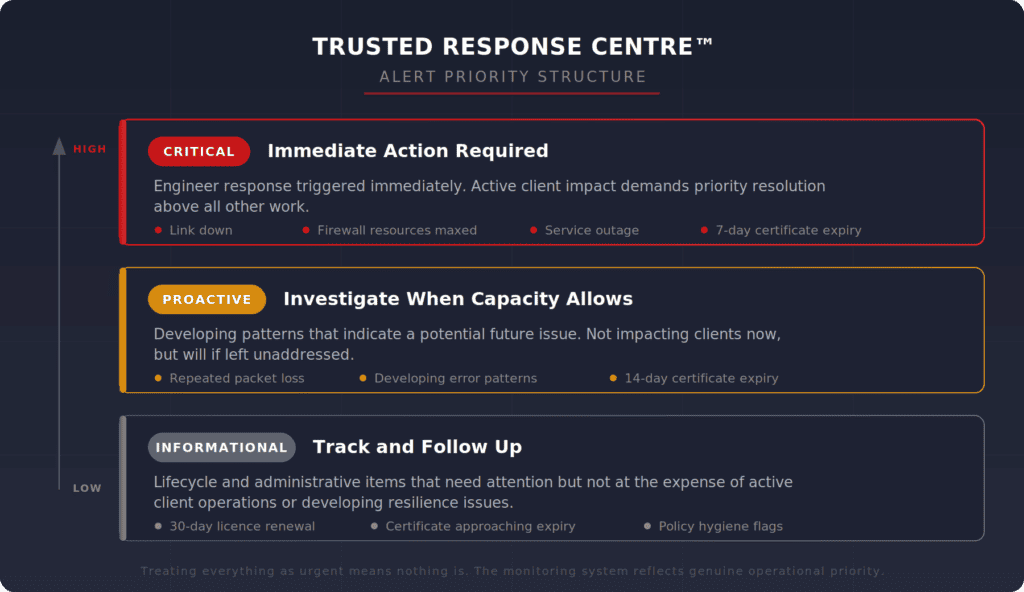
Our operational model resolves this challenge through a clear three-tier hierarchy inside the Trusted Response Centre. Critical alerts receive immediate engineering triage to maintain uptime, proactive metrics track capacity trends before lines drop, and informational alerts manage long-term administrative lifecycles. This systematic approach ensures that your security overlays and managed cyber security frameworks operate cleanly without unexpected interruptions.
“When your IT partner tells you about an expiring certificate thirty days before it becomes a problem, that’s not just good housekeeping — it’s proof that someone is genuinely watching your infrastructure rather than waiting for it to break.”