What the Cyber Security and Resilience Bill Means for UK SMEs: Shifting from Assumed Trust to Provable Governance
Regulatory Compliance • Cyber Governance Strategy
Strategic Summary: The UK’s upcoming Cyber Security and Resilience Bill is fundamentally redefining technology governance across the supply chain. Passing its report stage in the House of Commons on 14 May 2026, the bill places Managed Service Providers (MSPs) directly under statutory compliance mandates. While smaller enterprises may not face direct immediate regulation, enterprise procurement and supply-chain pressures mean UK SMEs must rapidly transition from trust-based security to documented, auditable cyber compliance.
The Core Mandate: Bringing Managed Service Providers into Scope
The Cyber Security and Resilience Bill represents the UK government’s legislative response to growing vulnerabilities within critical national infrastructure and the sprawling digital supply chains that feed it. The bill expands the existing Network and Information Systems (NIS) regulations framework, broadening the types of organisations legally obligated to demonstrate formal cyber governance while strengthening requirements surrounding immediate incident disclosure and vendor risk management.
For mid-market enterprises utilising outsourced technology support, the most significant shift is this: Managed Service Providers are now explicitly in scope. This means the protocols an MSP uses to lock down, monitor, patch, and recover the client networks they manage are no longer matters of optional professional best practice. They are transitioning into rigid compliance obligations.
The practical enforcement mechanisms are continuing to solidify as the legislation advances, but the underlying direction is absolute. Regulators, insurers, and enterprise corporate clients will increasingly demand provable, auditable cyber governance rather than assuming safety based on reputation. The central question an IT auditor or prospective client will ask is no longer whether your provider has good technical intentions; it is whether they can generate timestamped, unalterable telemetry confirming that specific perimeter controls are actively running.
The Domino Effect: Are Mid-Market SMEs Affected?
In the near term, the legislation focuses its heaviest compliance burdens on operators of critical infrastructure and essential digital utilities. The vast majority of standard British SMEs operating across professional services, logistics, localised manufacturing, or boutique financial sectors will not fall directly under the primary regulatory reporting mandates.
However, modern supply chain obligations introduce massive indirect pressure. If your mid-market business acts as a subcontractor or services vendor to larger enterprise entities that are directly in scope, those corporate clients will legally require clear evidence of your internal security posture before extending or renewing B2B agreements. Furthermore, because your IT provider is now specifically regulated as an MSP, their independent certification status becomes a foundational element of your own corporate risk profile.
This trickledown adoption pattern closely mirrors the historical rollout of GDPR. While small firms were rarely the primary targets for massive data privacy investigations, the sweeping compliance mandates placed on their larger suppliers and corporate buyers quickly changed market expectations for everyone across the board.
The Practical Blueprint: Moving from Trust to Telemetry
This legislative transition forces a permanent shift away from informal, trust-based IT management toward an objective, evidence-based resilience architecture:
- Documented Verification over Promises: Operating on the general assumption that your IT provider is “handling things” or that backup states are “adequate” is no longer defensible. Every core asset must possess clear, auditable tracking data.
- Active Control Mapping: MSPs must be capable of presenting verified data logs for every client node, proving that patching rhythms, endpoint rules, firewall policies, and immutable backup systems are current and functioning.
- Procurement Preparedness: Businesses must establish clear internal frameworks to answer inbound client risk questionnaires with specific technical evidence rather than generalised corporate assurances.
The Four-Stage Cyber Governance Certification Pathway
For UK enterprises seeking an accessible, structured pathway to achieve verifiable compliance, the National Cyber Security Centre’s (NCSC) framework remains the absolute gold standard. Grounding your infrastructure in these milestones systematically addresses the vulnerabilities that account for the large majority of modern automated cyber attacks.
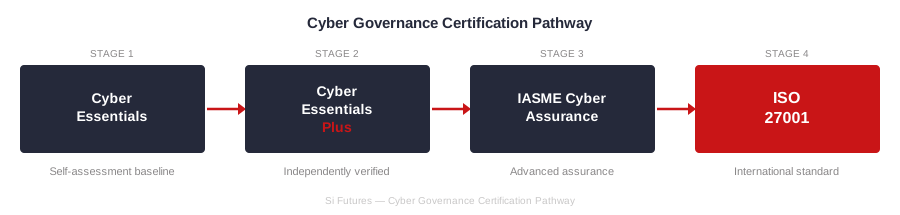
Figure 1: The structured maturity path from baseline Cyber Essentials through to international ISO 27001 validation.
For organisations that have not yet formalised their perimeter security, executing a Cyber Essentials alignment is the critical first step. This baseline focuses on five foundational control fields: boundary firewalls, secure system configuration, user access controls, malware defense, and patch management software deployment. Achieving this certification validates the core infrastructure patterns that enterprise procurement questionnaires scrutinise.
Once baseline alignment is secured, companies can progress to Cyber Essentials Plus, which replaces standard self-assessment with independent, hands-on technical verification of your active endpoints. From there, adopting IASME Cyber Assurance protocols and eventually pursuing comprehensive ISO 27001 alignment provides highly robust, internationally recognised proof of corporate data governance maturity.
The Si Futures Standard: Proving Our Frameworks
As a unified technology group operating across both the United Kingdom and South Africa, Si Futures is currently executing this exact certification pipeline across our own international operational estates. For our teams, this is not an aesthetic badge-hunting exercise; it is the process of embedding the rigorous, auditable logging systems that allow us to instantly answer any client query with verified, timestamped data.
For the businesses we protect, this structural investment means that the security frameworks we have always deployed in the field are now backed by ironclad documentation. This structural transparency insulates our clients from shifting insurance mandates and positions them ahead of enterprise buyer expectations.
If your UK enterprise is reviewing its current risk configuration and is uncertain how it will satisfy the strict vendor compliance audits on the horizon, the time to begin preparing your systems is now. A successful transition requires a clear-eyed look at active data flows, identifying hidden access vulnerabilities, and executing step-by-step infrastructure hardening before a commercial requirement or an unexpected perimeter breach creates a crisis.
Strategic corporate leadership means looking past passive IT management to build a provable, auditable posture of operational resilience today.